Blog - Outside Counsel Demand Is Rising. Is Your Firm Ready to Deliver?

Corporate legal departments are carrying more pressure from every direction. Regulatory scrutiny is wider, investigations are heavier, litigation is more expensive, and budgets are still tight. That pressure is sending more work to outside counsel, but it’s not creating easy growth for law firms. It’s creating a tougher operating environment where firms must deliver faster, staff more carefully, and justify value more clearly.
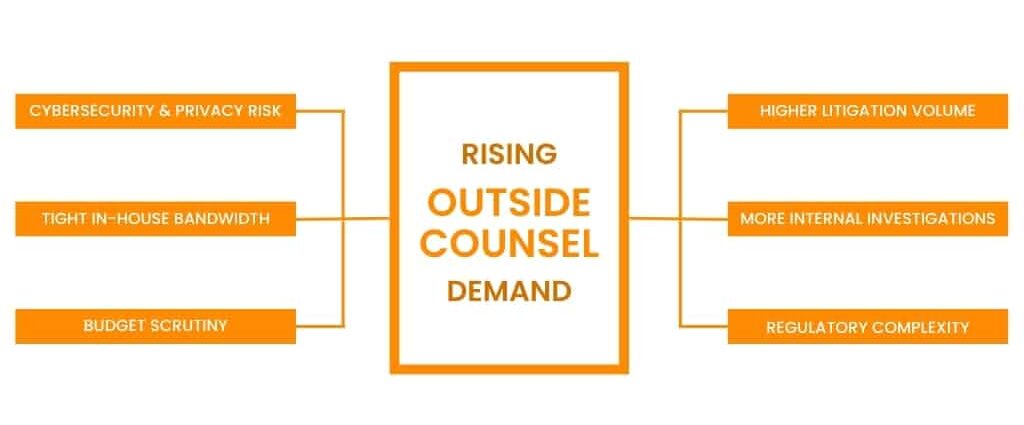
ACC’s 2025 Chief Legal Officers Survey shows the shift plainly: 43% of chief legal officers expect to increase the volume of work outsourced to law firms, while 42% report higher litigation volume, 44% report more internal investigations, and 60% report higher litigation expense.
So, if more companies are sending legal work out, why do so many firms still feel stretched thin? Why does higher demand so often feel less like momentum and more like pressure?
Additional business in the form of outside counsel work is only beneficial when a firm has the right attorneys, paralegals, and support staff ready to handle it well. Law firms are now feeling the pressure because clients are becoming more selective about which work goes out, who gets it, and how performance is judged once the matter starts.
Because of this increasing pressure, law firms should be thinking more critically about who they’re staffing, what kind of services they can offer and how the work is managed within the firm.
Why More Legal Work Is Moving to Outside Counsel
Companies aren’t using outside counsel more often because they suddenly prefer external help for ordinary matters. The shift is happening because many legal problems have become harder to absorb inside the department.
ACC’s 2025 survey points to the main pressures: Litigation volume is up, internal investigations are up, regulatory complexity is up, and outside counsel usage is rising alongside those pressures, not apart from them.
The use cases for outside counsel make practical sense. A routine commercial review can stay inside the company’s legal department. A multi-jurisdiction privacy issue, a sensitive employment investigation, or a lawsuit that starts attracting executive attention usually cannot. Those matters demand specialized judgment, immediate bandwidth, or both.
The broader allocation data helps explain what’s really happening. CLOC reports that legal departments now allocate about 60% of work to in-house teams, 35% to outside counsel, and 5% to other providers such as ALSPs. This is a sign that companies are making sharper decisions about which legal matters stay inside, what goes to firms, and what can be handled somewhere else.
While more work is moving to outside counsel, much of it is the work that’s harder, more urgent, or harder to staff internally. Law firms aren’t simply seeing more volume; they’re seeing more consequential volume.
Why Rising Demand Does Not Automatically Help Law Firms
A law firm benefits from new business only when it can absorb the challenge without dragging down response time, overloading existing teams, or weakening the quality of the work. That’s where the pressure starts to show with the current rising demand.
A practice group that looked fine on paper can start wobbling once two urgent matters hit in the same month, or one key team member leaves at the wrong time. Demand exposes weakness faster. It turns small hiring gaps into operational problems.
CLOC’s 2025 data shows that 83% of legal departments expect demand for legal services to keep growing, while 63% identify workload and resource bandwidth as their top challenge. Corporate legal teams are under strain already, which is one reason they’re leaning harder on outside counsel. But law firms can end up feeling the same squeeze if the incoming work arrives faster than the team can realistically carry it.
The Real Bottleneck: Legal Talent
The first pressure point is often lateral attorney talent. Outside counsel demand tends to favor work that needs experienced lawyers who can enter a live matter quickly and make sound decisions without much runway.
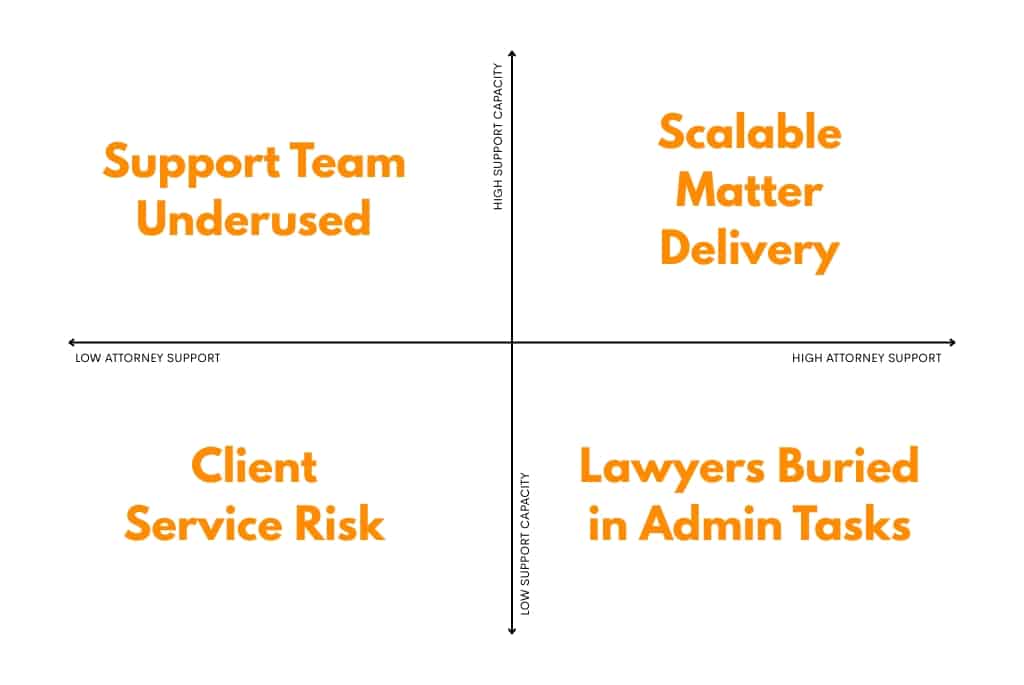
The second pressure point is support capacity. Firms often talk about lawyer headcount as if it tells the whole staffing story. It doesn’t. Paralegals, legal assistants, litigation support, docketing, and case management staff often determine how much work a team can actually move through the system. A firm can add a lawyer and still feel underwater if the support structure is weak.
The third pressure point is hiring speed. When a role stays open too long, the work doesn’t disappear; it lands on someone else’s desk. That usually means senior lawyers covering for gaps, midlevel associates getting stretched across too many matters, or support staff operating at a pace that’s hard to sustain.
Each of these pressure points brings us to a different type of staffing issue. Legal teams need support roles and specialized talent that can be hired quickly when matters arise. If your firm doesn’t have a healthy hiring pipeline or work with a recruitment firm that knows how to find specialized legal talent, you may struggle to meet demands when necessary.
What This Means for Law Firm Hiring Strategy
Hiring Speed Becomes a Competitive Issue
When firms move too slowly in the hiring process, they increase the strain on the people already carrying the burden of the work. That can show up in slower response times, weaker matter staffing, and more turnover among strong performers who get tired of covering open roles.
If your team is lacking a healthy pipeline of candidates or a way to source candidates when you need to fill new roles, you’re already at a disadvantage when it comes to competing for new outside counsel business. If you don’t have the staff to compete for the rising demand, you’re going to lose business to companies who were more prepared.
Employer Brand Matters More Than Many Firms Think
A weak hiring process tells candidates more than firms think it does.
Candidates notice when the interview process drags, when communication is inconsistent, or when no one can explain why the role is open. They read that as a preview of how the firm operates. The strongest candidates usually have options, so when they see a firm whose process looks like a mess, they simply move on.
That is why employer branding matters. It’s not about polishing language on a careers page or coming up with the perfect mission statement; it’s about portraying your firm in a way that looks organized, credible, and worth joining. Good candidates need to be convinced. They want to know what kind of work they will do, who they will work with, how the team is managed, and why the opportunity is better than staying put or moving in-house.
This matters more now because clients are not choosing outside counsel on name recognition alone. CLOC found that the expertise of a particular lawyer matters more to buyers than general firm reputation, and knowledge of the client’s organization ranks highly too. That means firms need to attract people clients will trust quickly, not just people who fill a seat.
Flexibility and Role Clarity Shape the Talent Pool
Candidates now care about more than just pay. They want to see a role that’s well defined and is reasonable in its expectations.
Flexibility matters because candidates want to understand how the job fits into their everyday life. They look at schedule expectations, hybrid arrangements, responsiveness norms, and whether the firm’s culture supports sustainable performance or constant fire drills. Not every role can offer broad flexibility and most candidates know and accept that. What candidates are no longer willing to accept is rigidity without reason.
Role clarity matters just as much. Good candidates want to know what success looks like before they say yes. They want to understand the type of work, the level of responsibility, the reporting structure, and the likely path forward. When firms are vague, candidates tend to assume the worst. A fuzzy role description can signal internal confusion, unrealistic expectations, or a job that was approved before anyone defined what the team actually needs.
Firms with clear, credible roles and workable expectations tend to attract stronger candidates and lose fewer of them mid-process. Firms that stay vague or inflexible often end up with a smaller pool and slower searches.
How Firms Can Respond Before Staffing Pressure Affects Client Service
Audit the Areas Where Work Is Backing Up
The first step is diagnosis.
Firms need to know where work is slowing down and why. Some practice groups have enough lawyers but not enough support staff. Others have talented partners but a missing layer of midlevel execution. Some groups are not understaffed at all; they’re simply hiring too slowly when openings appear.
Taking the time to fully understand the issue you’re facing will allow you to take more strategic steps towards fixing the issues without trial and error.
Tighten The Hiring Process
A drawn-out process feels expensive because it is expensive.
Firms that benefit most from rising outside counsel demand usually make faster decisions, narrow the role definition earlier, and reduce unnecessary drag between interviews. That doesn’t mean being careless or rushing through the process. It means understanding that every week of delay has an operational cost once demand is already climbing.
Taking the time to strategically optimize your hiring process or working with a legal recruiter can help reduce the cost of the hiring process and increase your chances of successfully landing new business.
Build Bench Strength Before the Market Forces It
The stronger firms don’t wait until a team is overloaded to think about staffing. They watch where demand is bunching up and where a single departure would create real strain. They think in terms of bench strength, not just open requisitions.
Clients are becoming more formal in how they evaluate law firms. CLOC reports that 38% of legal departments have already implemented or are refining structured annual law firm evaluations, with another 17% planning to adopt them. At the same time, the ABA’s guidance on outside counsel relationships emphasizes responsiveness, understanding the client’s business, actionable planning, and the smart use of technology and data.
That means staffing discipline now has a more direct path to client retention than many firms acknowledge. Firms are not judged only by legal analysis. They are judged by how the entire service experience holds together under pressure.
The Firms Best Positioned to Benefit from Outside Counsel Growth
The firms best positioned here are not automatically the largest firms or the firms with the loudest brand presence.
They’re usually the firms that understand three things:
- Rising outside counsel demand is selective. The work coming out is often the work that is harder, more urgent, and less forgiving of weak staffing.
- Hiring is tied directly to service quality. A thin bench does not stay hidden for long when clients are tracking performance closely.
- Support roles matter more than firms sometimes admit. Strong paralegal and legal operations support can protect throughput, preserve lawyer time, and keep matters moving when demand spikes.
Final Takeaway
Outside counsel demand is rising because legal departments are facing more complexity, more disputes, and more pressure on internal bandwidth. The opportunity for law firms is real, but it’s largely dependent on the firm’s ability to properly staff its team.
The firms most likely to benefit from this spike in demand are the ones that hire faster, staff more deliberately, protect support capacity, and treat recruiting as part of client service rather than as a separate administrative task.
For teams looking for legal staffing support, the team at Prime Legal is here to help. Reach out to our team today to learn more about the services we offer or to discuss the issues that your firm is facing.
