Blog - Why Lateral Hiring Is Dominating Legal Recruiting Right Now

Lateral hiring has moved from a supporting tactic to the backbone of legal recruiting. In 2026, firms across the United States rely on lateral moves to add capability, protect revenue, and respond to client pressure with speed. This shift reflects how law firms now grow, compete, and manage risk.
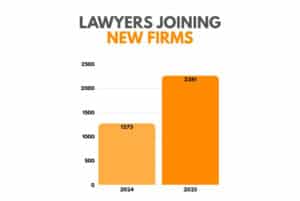
The scale of lateral activity underscores that reality. In 2025 alone, firms from the AmLaw 200 group made more than 13,000 non-entry-level lateral hires, the highest total since the post-pandemic peak of 2021-2022. Lateral hiring is no longer supplemental. It is how most firms are staffing the business.
The numbers support the shift. According to the National Association for Law Placement, lateral associate hiring rose sharply in 2024 and remained elevated through 2025, accounting for the majority of net hiring growth at large firms. That rebound did not come from entry-level classes. It came from experienced lawyers changing seats.
Firm-level data reinforces the point. While associates represented the largest share of lateral hires (58%), growth was driven disproportionately by senior talent. Partner hiring reached a five-year high in 2025 (3,009 hires, up 10%), while counsel hiring rose at an even faster pace (up 12% from 2024), reflecting firms’ increasing reliance on experienced attorneys who can deliver immediate value.
Understanding why lateral hiring dominates requires looking beyond compensation wars and into how the legal market functions today.
Why Lateral Hiring Has Become Central to Legal Recruiting
Immediate Capability Matters More Than Pipeline Depth
Clients expect experienced judgment, not long ramp-up periods. They also expect firms to staff matters with lawyers who have handled similar issues before. Lateral hiring solves that problem cleanly. An attorney with five to ten years of relevant experience can step into active matters, manage junior staff, and interact with clients immediately.
This is especially true in litigation, private equity, regulatory compliance, and complex transactions. Litigation, in particular, has emerged as the single most active practice area for lateral hiring across all experience levels, accounting for the largest share of partner (26%), counsel (28%), and associate (36%) moves in 2025. Firms cannot afford to wait several years for associates to mature when clients are pressing for results now.
The Talent Market Rewards Mobility
Lawyer unemployment remains low, and demand for experienced talent continues to outpace supply. As a result, most lateral candidates are already employed. Firms are recruiting from competitors, not from the sidelines.
Reuters’ documentation of legal industry movement shows sustained lateral activity through 2025, with thousands of attorneys changing firms even as overall hiring stabilized. Lateral movement has become a normal career mechanism rather than a signal of dissatisfaction. Lateral movement has become a normal career mechanism rather than a signal of dissatisfaction.
This dynamic reshapes legal recruiting strategy. Firms that hesitate or over-engineer decisions lose candidates to faster competitors.
Growth Strategy Drives Lateral Demand
Lateral hiring increasingly supports strategic expansion rather than backfilling departures. Firms use targeted lateral additions to enter new practice areas, deepen sector expertise, or establish a presence in growth markets.
Recent hiring patterns reflect this shift. Senior-level lateral hiring has outpaced associate growth, with partner and counsel hiring both reaching five-year highs. Washington, D.C. has emerged as a focal point for this activity, ranking among the top markets for partner and counsel hires as firms invest in regulatory, enforcement, and government-facing capabilities.
Group lateral hires have become more common for this reason too. Entire teams move together, bringing clients, workflow, and internal cohesion. Attorney at Law Magazine reports a continued rise in group lateral hires as firms accelerate office launches and practice expansions.
This approach compresses years of organic growth into months.
How Lateral Hiring Is Reshaping Legal Recruiting
Speed Has Become a Competitive Advantage
Legal recruiting used to tolerate long deliberation. That model no longer works in a lateral-driven market. Top candidates expect momentum, clarity, and decisive communication.
With more than 13,000 lateral moves occurring in a single year, firms are competing in a high-velocity environment where timing matters. Lateral activity peaked in mid-year, driven largely by associate movement, and firms that moved quickly consistently captured stronger candidates.
Firms now track time-to-interview and time-to-offer with the same seriousness once reserved for billable metrics. Legal News Feed reports that firms investing in faster internal approvals and streamlined interview processes close more lateral hires than firms that rely on legacy workflows.
Speed signals seriousness. Delay signals doubt.
Evaluation Has Become More Analytical
Lateral hiring carries risk, particularly at senior levels. Firms have responded by becoming more data-driven in candidate assessment. Beyond resumes, recruiting teams analyze billing histories, client concentration, practice mix, and evidence of cross-selling potential.
This analytical shift reflects a broader trend toward treating lateral hires as strategic investments rather than replacements. Industry commentary notes growing use of performance metrics to forecast integration success and long-term contribution.
Firms that rely purely on reputation or pedigree expose themselves to expensive misfires.
Compensation Has Grown More Customized
Lateral hiring has also reshaped compensation structures. Portable business, niche expertise, and leadership potential now influence pay as much as seniority. Signing bonuses, guaranteed compensation periods, and tailored partnership tracks are common, particularly for partners and senior counsel.
This flexibility reflects market reality. Experienced lawyers with options expect offers that recognize their specific value.
What Lateral Candidates Are Optimizing For
Career Trajectory Over Short-Term Gain
Many lateral moves are proactive rather than reactive. Mid-level and senior attorneys increasingly seek platforms that support long-term growth, clearer advancement, or stronger alignment with their practice focus.
A litigation associate moving from a broad practice firm to a boutique trial shop is often optimizing for specialization, not compensation alone. Legal recruiting conversations reflect this shift toward intentional career positioning.
Firm Clarity and Culture Matter More Than Branding
Candidates scrutinize leadership transparency, workload expectations, and integration support. Hybrid work policies, mentorship access, and decision-making structure influence lateral decisions as much as headline compensation.
Firms that cannot clearly explain how a lateral hire will succeed internally struggle to convert interest into acceptance.

Structural Forces Sustaining Lateral Hiring Dominance
Client Pressure Compresses Development Timelines
Clients resist paying premium rates for learning curves. That pressure pushes firms toward lawyers who already know the work. Lateral hiring becomes a way to maintain quality while managing client expectations around efficiency and cost.
Regulation and Specialization Accelerate Mobility
Emerging regulatory areas such as data privacy, AI governance, and industry-specific compliance reward specialization. Firms often lack internal talent depth in these areas and turn to lateral hiring to close gaps quickly.
Reuters’ coverage of legal market transformation notes that regulatory change continues to fuel targeted lateral movement, particularly at the partner level.
Common Misreads of the Lateral Market
Lateral hiring is not limited to rainmakers. Associates with four to eight years of experience are among the most actively recruited segments because they combine skill with runway.
It also does not replace internal development. The strongest firms blend both. They build talent internally while using lateral hiring to address timing, specialization, and scale.
What Firms Need to Get Right In 2026
Firms that win in a lateral-driven market define their value proposition clearly. They move decisively. They evaluate candidates with rigor and integrate them deliberately.
Strategic workforce planning matters more than ever. SurePoint research emphasizes that firms aligning hiring decisions with long-term growth strategy outperform those reacting tactically to departures.
Conclusion
Lateral hiring dominates legal recruiting because it matches how law firms now compete. It delivers immediate capability, supports strategic growth, and aligns with how experienced lawyers manage their careers.
Firms that treat lateral hiring as a core business function rather than a reactive necessity will continue to attract stronger talent. Prime Legal works with firms and candidates navigating this reality, helping both sides make informed, strategic moves in a market defined by mobility and precision. To learn more about the services Prime Legal provides, reach out to one of our team members!
