Blog - Record Legal Market Hiring Numbers: Insights into the Legal Hiring Demand in 2026

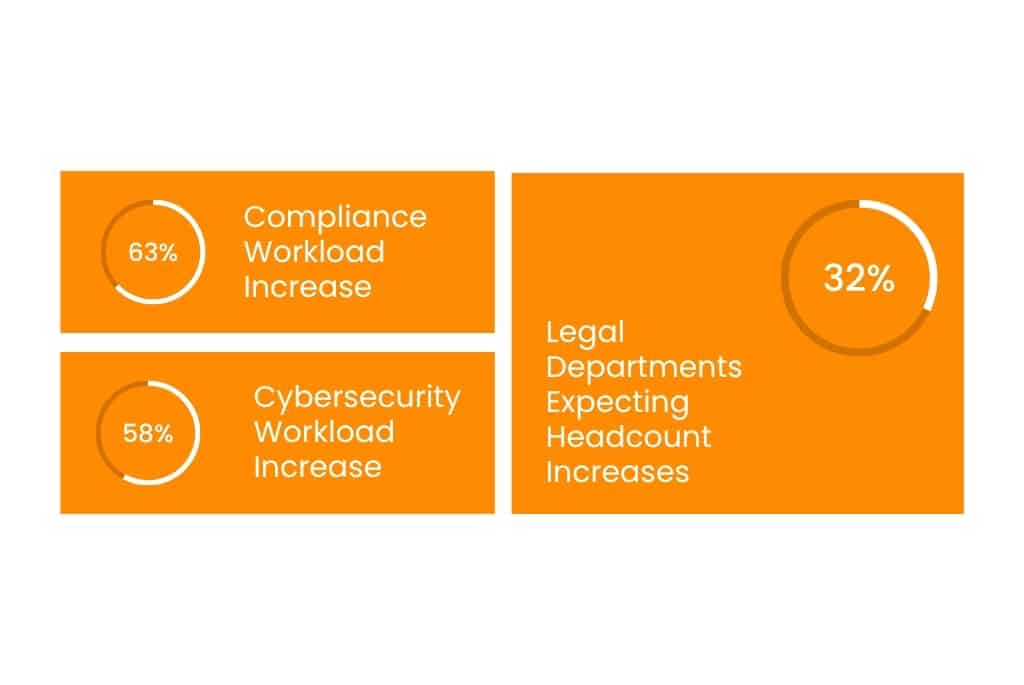
Legal teams are carrying more risk, more regulatory noise, and more technology oversight than they were a year ago. Workload is climbing in the areas that are hardest to staff, while budget growth and attorney headcount growth are moving much slower. CLOC’s 2026 industry report puts hard numbers on that squeeze: demand is rising fastest in regulatory compliance and cybersecurity, yet only 32% of departments expect attorney headcount increases.
That leaves legal executives, hiring teams, and recruiters asking a practical question: If legal hiring demand is strong, why do so many teams still feel constrained?
The answer sits in the gap between demand and buying power. Thomson Reuters found that 2025 became the third best year for law firm demand growth since the global financial crisis, with the average firm posting 1.9% annual demand growth and a 3.9% year-over-year spike in Q3. At the same time, CLOC found that only 37% of departments expect outside counsel spend to rise and only 47% expect inside legal spend to increase.
That changes the hiring conversation. In 2026, legal recruitment is less about broad expansion and more about targeted capacity. Teams still need talent. They just need it in tighter, more business-sensitive ways. The firms and departments that handle this well will be the ones that define roles more clearly, hire faster for specialized work, and use legal staffing as a tool for capacity planning instead of treating every spike in workload as a case for a permanent hire.
Legal Hiring Demand Is at Record Levels, But It’s Selective
The market is strong and there’s no reason to pretend otherwise. The U.S. Bureau of Labor Statistics projects about 31,500 openings for lawyers each year through 2034 and about 39,300 annual openings for paralegals and legal assistants. Across legal occupations as a whole, BLS projects roughly 83,800 openings per year.
The pipeline has held up better than many expected, too. NALP reported that the Class of 2024 reached a 93.4% overall employment rate, the highest ever recorded, even though the class was much larger than the one before it. The ABA’s 2025 Profile of the Legal Profession also found that the U.S. lawyer population rose to 1.37 million in 2025 from 1.35 million in 2024, the first meaningful increase since 2020.
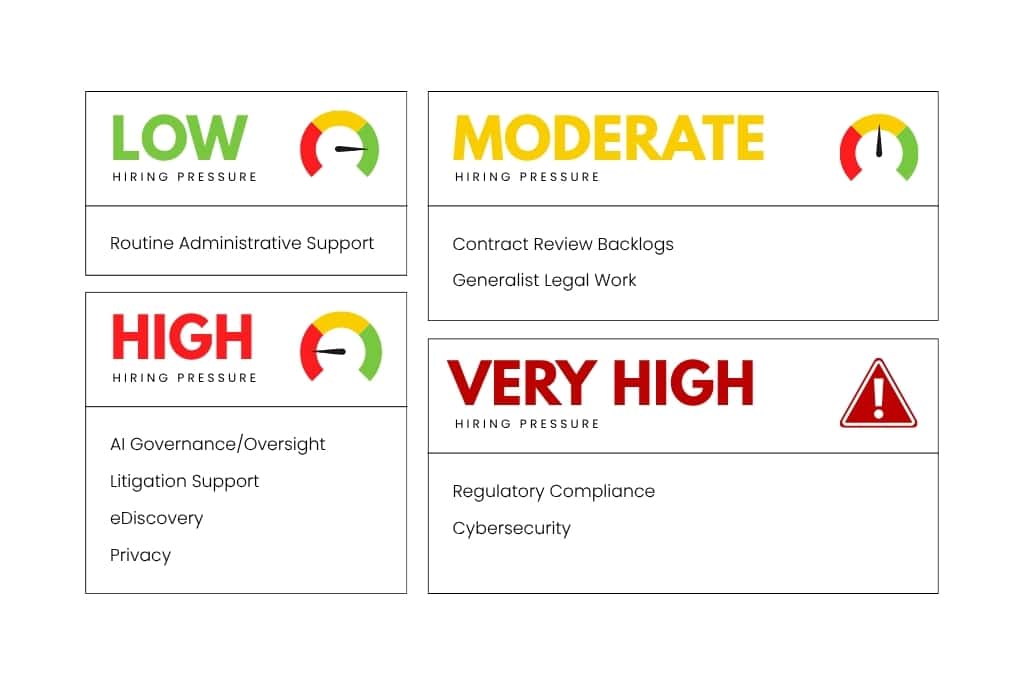
Still, a consistent pattern emerges. Hiring demand is strongest where the work is risk-heavy, specialized, or operationally urgent. That’s a very different market from a broad hiring boom. A legal department may have no appetite to add three generalist lawyers, but moves quickly for one privacy counsel, one compliance hire, or one litigation support professional who can absorb a flood of work next quarter.
Why More Legal Work Does Not Automatically Lead to More Staff
Rising legal demand doesn’t guarantee broader hiring approvals. In-house teams are under pressure to contain spending even while the work gets harder.
CLOC’s 2026 report gives us a clear picture of this: Regulatory compliance departments workload rose by 63% and cybersecurity workload rose by 58%, yet only 32% expect attorney headcount increases. Expectations for outside counsel spend fell sharply from 58% to 37%, and expectations for inside legal spend increases fell from 65% to 47%. That’s the shape of the market recruiters are working in. More work. More scrutiny. More financial discipline.
The same pressure shows up in corporate legal sentiment. Thomson Reuters’ 2025 State of the Corporate Law Department Report (based on more than 2,400 interviews with general counsel) found that GCs are talking far more about value and efficiency than they were a year earlier. That usually leads to tighter role definitions, tougher questions about return on hire, and more willingness to shift work instead of simply adding permanent staff.
Where Hiring Pressure Is Building Fastest
The strongest demand is not evenly distributed across the profession. It’s clustering in the areas where legal risk has become less predictable and more visible to the business.
Compliance and cybersecurity are the clearest examples. CLOC found those were the two most common areas of rising workload in 2026. That alone tells legal recruiters where urgency is building. Work connected to AI is becoming part of the same story. CLOC reports that 85% of legal departments now have dedicated AI oversight or resources, which is a remarkable shift from the pilot-stage conversation that dominated not long ago.
There’s also a quieter shift happening under the surface. The legal market is rewarding professionals who can work in tech-enabled environments without slowing the team down. The ABA’s 2024 AI TechReport describes AI adoption in law as real but uneven, with mainstream integration still developing.
The market increasingly rewards subject matter expertise plus operational adaptability. A privacy lawyer who can function inside a disciplined, AI-governed department is more valuable than a strong lawyer who needs the whole system to bend around old habits.
What Smart Legal Recruitment Looks Like In 2026
The obvious mistake is to treat every demand spike as a permanent hiring need. The other obvious mistake is to freeze and hope the pressure breaks. Neither works for long.
The stronger approach starts with workload design. Ongoing, judgment-heavy work may justify permanent hiring. Shorter bursts of litigation support, contract review, investigations, eDiscovery, or regulatory cleanup often call for a different model. Thomson Reuters’ 2025 ALSP report found that 57% of corporate law departments already rely on alternative legal services providers for work that includes flexible resourcing, eDiscovery, and litigation support.
The best legal recruitment strategies in 2026 start with choosing the right model for your needs.
What Must Be Hired Permanently
These are roles tied to sustained institutional judgment, repeated business partnering, or sensitive decision-making. Senior compliance counsel is a good example. So is a lawyer embedded in a business line that keeps generating the same class of risk.
What Should Be Staffed Flexibly
Surge work belongs here. A company facing a temporary regulatory review, document-heavy litigation, or a contract backlog may need capability now, not a nine-week interview cycle. Flexible legal staffing can solve a real business problem faster than a perfect permanent search.
What Can Be Redesigned Operationally
When a team is drowning in work, the answer isn’t always another requisition. Sometimes it’s a clearer intake, better workflow, or tighter vendor use that can help relieve the pressure on your team.
Having a legal recruiter who can speak credibly about operating models will be useful to legal firms searching for talent. A search partner who understands where a role fits inside a department’s workflow becomes a valuable asset.
The Market Is Also Rewarding Faster, Sharper Hiring Decisions
Strong demand doesn’t just raise competition for talent. It punishes indecision.
The profession still has healthy supply signals, but that doesn’t mean specialized candidates wait around while a hiring team debates title language for three weeks. BLS data shows meaningful annual openings for both lawyers and legal support roles, and the law graduate market has stayed resilient. That combination creates movement. Good candidates have options, even in a market where overall financial discipline is tighter.
That has two implications for recruitment strategies.
First, intake matters more. A vague brief usually leads to a slow, expensive search.
Second, compensation and scope have to match reality. BLS puts the median annual wage for lawyers at $151,160 and $61,010 for paralegals and legal assistants as of May 2024. Those are medians, not guarantees, but they provide a reality check when hiring teams expect niche skills at yesterday’s price.
The Real Hiring Advantage In 2026
The legal teams that perform best this year probably won’t be the ones that open the most requisitions. They’ll be the ones that treat legal hiring demand as a capacity problem with financial constraints attached.
Law firm demand was unusually strong in 2025. In-house workload is rising in some of the hardest areas to staff. The pipeline is healthy enough to support movement, but budgets are not expanding at the same pace. That combination favors legal executives and recruiters who can match role type to workload, move quickly on specialized talent, and use legal staffing with more precision.
Legal hiring demand is real in 2026 and the edge comes from handling it with more discipline than the market around you. For firms looking for discipline and a faster, more targeted hiring process, work with the team at Prime Legal on your next legal staffing search!
