Blog - How Legal Recruiters Help Candidates Land Better Legal Jobs

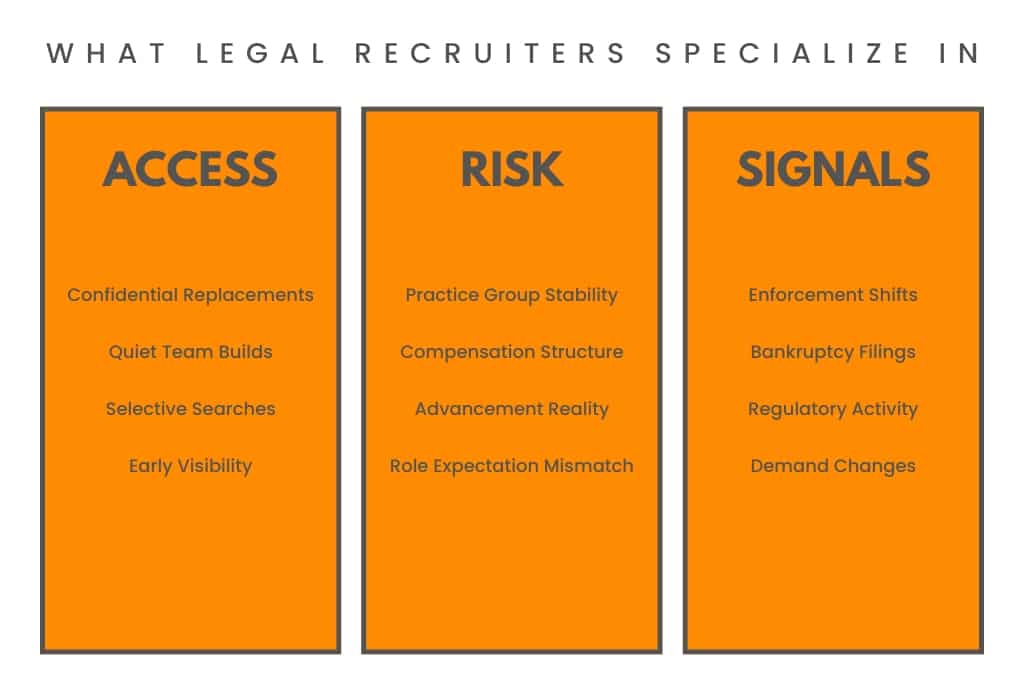
U.S. legal hiring runs on three forces that candidates rarely track at the same time: access (who hears about what), risk (how expensive a wrong move becomes), and market signals (what shifts demand before job postings change). Legal recruiters make a difference when they operate in those three lanes, not when they act like a résumé forwarding service.
This piece explains what legal recruiters can do in practice for a candidate’s legal career, where the value is real, and how to spot the difference between a recruiter with market leverage and one with a contact list and a script.
The Legal Job Market Rewards Access More Than Applications
Job boards create a comforting illusion: the best roles appear publicly, the best candidates apply, and the market sorts itself out.
Legal hiring rarely works that cleanly.
The American Bar Association’s Profile of the Legal Profession documents a profession with steady movement, demographic pressure, and uneven distribution across practice settings. Lateral hiring fills gaps constantly, often faster than public posting cycles.
NALP’s reporting on jobs and hiring outcomes also supports the idea that many moves happen through structured channels inside the profession rather than through broad public advertising.
The practical takeaway is simple: a candidate competing only through open postings competes in the most crowded lane.
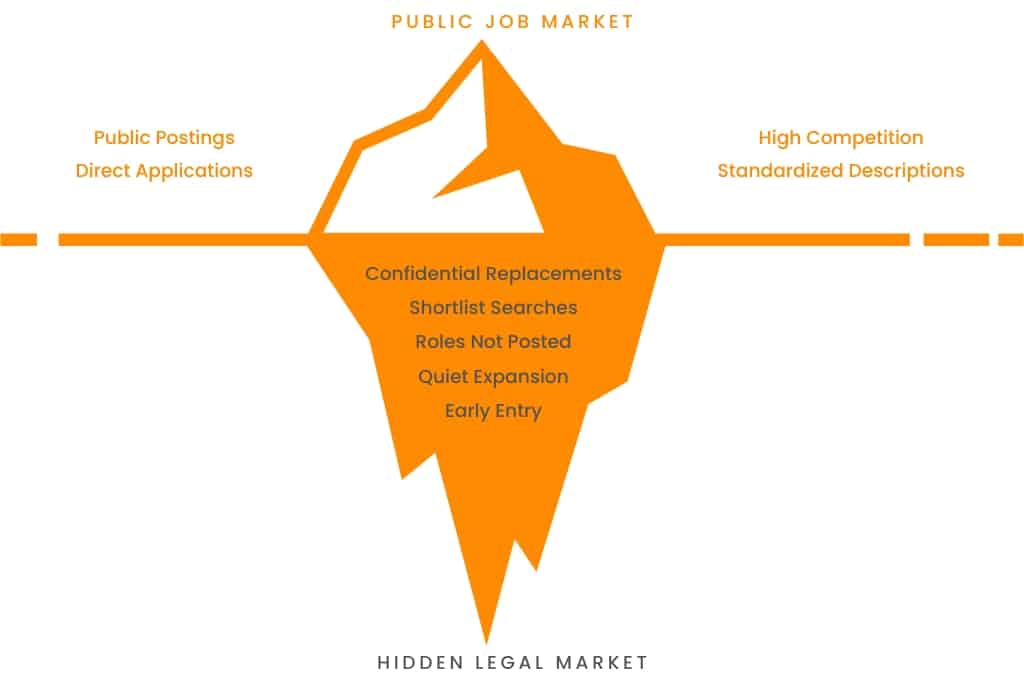
What the “Hidden” Market Looks Like in Legal Recruitment
When people talk about the “hidden market” in legal jobs, here is what it usually means:
- Confidential replacements: a partner exit, a group leader change, a GC succession plan
- Quiet capacity builds: a firm wins a client and needs staff quickly without broadcasting it
- Selective searches: a department wants three very specific profiles and wants to avoid a public applicant flood
- Timing gaps: the role exists, but leadership wants a short list before posting publicly
A recruiter’s value comes with their access to this hidden market. Without a legal recruiter with this inside information, candidates rarely (if ever) hear about the jobs until it’s too late.
How Legal Recruiters Create Access That Candidates Cannot Replicate Easily
Legal recruiters build access in two ways: relationships and repeat transactions. Neither happens quickly.
In one survey, researchers found that 32% of workers credited their job hunt success to personal connections and 28% credited it to professional connections.
Legal hiring intensifies that effect because firms and legal departments treat bad hires as high-cost events. They prefer fewer, better-vetted introductions.
A recruiter who specializes in legal staffing earns the right to call a practice group leader and get a real answer to a real question: “Is the group actually growing, or is this a backfill after attrition?”
That type of relationship and information cannot be found on a job board.
What Access Changes for a Candidate’s Options
Access changes three things that candidates care about:
- Timing: Earlier entry into a hiring process reduces competition and increases negotiating leverage for the candidate.
- Fit: Recruiters can align a candidate with the decision-maker’s actual priorities instead of the candidate having to guess what they want from the job description.
- Scope: Access expands the set of possible career moves, including roles that never become public.
A mid-level litigator, for example, may believe only one local firm is hiring. A recruiter may know two firms plan to expand quietly after trial wins and one in-house team that expects a new regulatory workload. Now the candidate has different career options from the same résumé that they may have never considered without the information from the recruiter.
The Wrong Lateral Move Costs More Than A Few Annoying Months
Candidates often treat lateral moves as reversible. In practice, a misstep can cost a year or more of momentum.
NALP regularly publishes associate attrition and mobility analysis, and the pattern stays consistent: many associates leave firms quickly because workload expectations, culture, advancement clarity, and practice stability differ from what the candidate expected.
The risk is not only burnout. It’s the narrative that a lateral move creates. A resume with short stints forces explanations, narrows options and can slow career advancement.
Why Partnership Promises Confuse Candidates
Some firms run clear partnership tracks with stable criteria. Others operate with large non-equity tiers and changing elevation standards. Candidates hear optimistic timelines because optimism sells.
The ABA’s market research resources provide broader context on how the profession’s structure changes over time, including demographics that influence succession pressure.
https://www.americanbar.org/groups/market_research/resources/
A recruiter who places repeatedly within the same firm often knows the truths about: who gets elevated, how long it takes, and what “business case” really means in that shop.
That knowledge matters most for candidates in the 5-12 year window where the career splits into distinct paths.
How Legal Recruiters Reduce Risk Without Turning into Career Coaches
In legal recruiting, risk reduction becomes practical when it focuses on three checks: stability, economics, and expectations.
Stability: Practice Groups Expand and Contract Quietly
A practice group can look healthy from the outside and still be unstable. A client leaves. A rainmaker departs. A firm shifts strategy.
The Thomson Reuters Law Firm Financial Index tracks demand, rates, and financial performance across the industry. Those indicators influence how aggressively firms hire and how quickly they pull back.
A recruiter can’t predict the future. What they can do is recognize patterns: firms with shrinking demand and rising costs tend to restructure, and restructures tend to hit non-core groups first.
These are the kind of insights that legal recruiters have thanks to years of experience in the industry. With this knowledge, they can plan and position you for the right roles at the right time.
Economics: Compensation Depends on More Than Salary
BLS data shows lawyer wages vary widely by state and metro area, and the range is not subtle. BLS also provides baseline occupation outlook information for lawyers.
Candidates still get tripped up because law compensation is a system, not a number. Bonus eligibility, hours expectations, origination credit, and class-year alignment can change total comp.
Recruiters who negotiate frequently can often translate the real offer:
- What hours and utilization the offer quietly assumes
- Whether the bonus structure is achievable in that group
- Whether the title aligns with market leveling or functions as a retention label
The clarity a legal recruiter is able to provide on these topics is what reduces risks for candidates.
Expectations: The Job Description Rarely Matches the Job
Hiring managers write descriptions to attract. Candidates read them as promises.
A recruiter who has placed in the same group can often give the simple clarifications that prevent disappointment:
- “The group sells X, but the work is mostly Y.”
- “This partner expects weekend responsiveness during deal cycles.”
- “The team operates like a litigation shop even though it sits in corporate.”
Those sentences sound small, but they save careers from going in the wrong direction.
Market Signals That Move Legal Hiring Before Candidates Notice
Candidates usually learn the market through personal workload and firm chatter. That provides only a narrow view of the market.
Regulatory and economic data often signal shifts earlier.
The EEOC publishes enforcement and litigation statistics that help contextualize employment law demand and enforcement activity.
The U.S. Courts publish bankruptcy statistics that correlate with restructuring cycles and related hiring demand.
The SEC publishes annual enforcement reporting that can foreshadow shifts in securities litigation and investigations work.
Recruiters who specialize in practice areas track these inputs because they affect client demand. Demand affects hiring. Hiring affects candidate leverage.
A skilled legal recruiter uses these resources to interpret the market and make strategic recruitment decisions rather than playing matchmaker between a candidate and a random firm.
A Forward-Looking Reality: Practice Areas Are Becoming “Signal Driven”
Legal work increasingly follows measurable external triggers: enforcement priorities, filing volumes, and regulatory change. Candidates who see practice demand as static tend to react late.
Recruiters who see multiple employers at once can spot early movement: a spike in compliance hiring, a pullback in transactional, an unexpected acceleration in investigations, a surge in labor and employment. Those shifts show up in calls and requisitions before they show up in public postings.
That timing advantage is hard for candidates to recreate alone.
Geography Shapes Careers More Than Candidates Expect
BLS wage data makes the salary point clear: geography changes compensation.
The more subtle point: geography changes opportunity structure.
Secondary markets often offer earlier responsibility and closer client exposure. Major markets often offer brand and depth, but also higher competition and more rigid leveling. Some candidates thrive in one environment and stagnate in the other.
BLS employment projections by detailed occupation provide one lens into how demand evolves over time, even if projections do not capture every local nuance.
Recruiters operating nationally can help candidates see these trade-offs before they make a move based on salary alone.
When Legal Recruiters Add the Most Value
Recruiters tend to matter most when the move is high-stakes or hard to evaluate from the outside:
- Mid-level associate lateral moves where leveling and trajectory matter
- Partner transitions where books, credit, and platform differ
- In-house moves where the role’s influence and scope are unclear
- Relocations where market pricing and title alignment shift
- Practice pivots where branding and narrative require careful handling
For entry-level roles and highly structured processes, recruiter impact can be limited. Some markets and roles remain transparent enough that a direct application works fine. A credible recruiter will say that out loud.
How Candidates Can Vet Legal Recruiters Without Getting Sold To
Candidates can evaluate recruiter quality quickly by asking questions that force specificity.
A recruiter worth engaging can answer:
- How many placements have happened in the target firm or department in the last year
- What the real hiring constraint is, not the posted requirements
- What usually derails candidates in that interview process
- How compensation is structured in that market and class-year band
A recruiter operating on volume will dodge and redirect while a good recruiter will have clear answers for you.
Incentives Exist, Good Recruiters Manage Them
Recruiters get paid when placements happen. That incentive can work for candidates when the recruiter plays the long game and protects reputation with clients.
It can work against candidates when the recruiter pushes speed over fit.
The safest signal is behavior: strong recruiters ask hard questions early, share uncomfortable truths, and sometimes advise against a move. That costs them short-term fees but it builds long-term leverage.
What Your Recruiter Should Be Accountable For
A legal recruitment partner in the United States should deliver more than introductions.
A credible firm should provide:
- Access to roles that match real decision-maker priorities
- Clear market pricing for compensation and leveling
- Risk screening based on stability, economics, and expectations
- Practice-area insight tied to public signals
That standard protects candidates and improves outcomes for employers.
Closing Thoughts
Legal recruiters help candidates find better jobs when they operate as access brokers, risk filters, and market interpreters.
A quality legal recruiter can help candidates get earlier entry into processes, cleaner lateral narratives, fewer bad moves, and better negotiations based on market truth rather than guesswork.
A high-quality legal recruiter like Prime Legal should offer fewer promises, more usable intelligence, and a process that respects the cost of being wrong.
To experience the benefits of having a legal recruiter on your side, get in touch with the team at Prime Legal to see how we can help you create a plan to advance your career. If you’re looking for current job openings, check out our job board to see the roles that are available now!
