Blog - Why Your Legal Support Roles Matter as Much as Your Attorneys
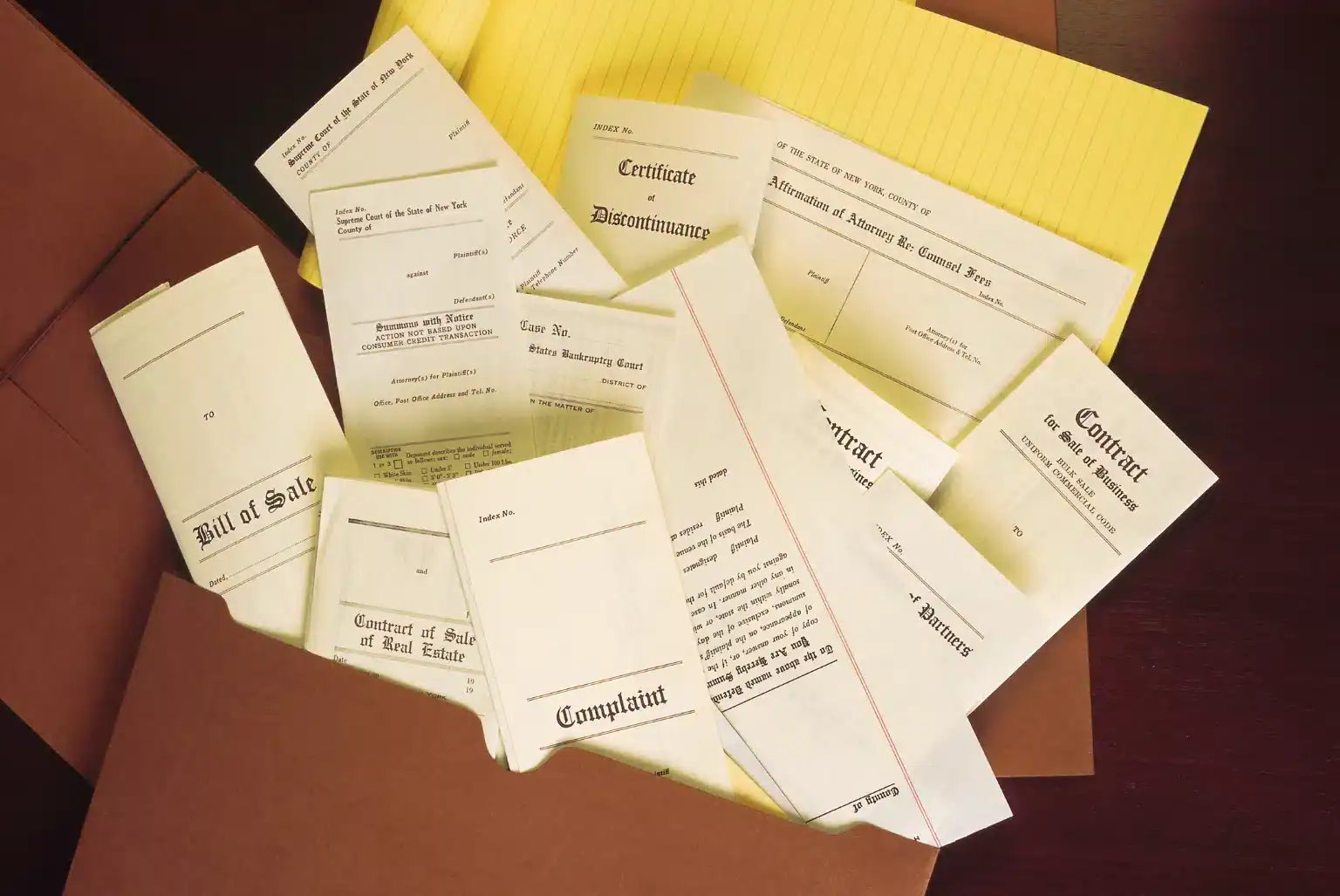
Having excellent attorneys is great, but if the team supporting them is too small, inexperienced, or overwhelmed, your attorneys won’t be able to perform. And with the rapid adoption of AI, the systems supporting attorneys are becoming more important than ever.
Richard Susskind, one of the most respected voices on the future of legal services, spoke to members of Axiom Law in a fireside conversation in London about the short-term effects of AI in the legal industry as well as the more “underestimated” long-term effects. In part of the speech, Susskind estimated that by the 2030s, “AI will not primarily be a tool for lawyers. It will be a tool that empowers non-lawyers to handle work that previously required legal experience. Organizations will meet their legal needs in ways that look nothing like the current model of in-house teams and outside counsel. Individual citizens and businesses will have access to sophisticated legal capabilities directly. The very premise of why a legal department exists may shift. “
If Susskind is right, the biggest change won’t be in the efficiency of existing processes. It will be a change to the process itself. In a few years, it may start with a client using AI, a business team using an internal tool, a self-represented litigant preparing a filing, or a legal process built into software before a lawyer ever gets involved.
When your team starts getting flooded with AI generated documents that need to be reviewed by someone with actual legal knowledge, where will the pressure land on your team? Which roles become the most important?
Paralegals, legal assistants, docketing staff, litigation support professionals, and practice managers are not just helping in the background. They keep the work organized enough for attorneys to make good decisions.
AI Is Changing What Comes Into the Firm
Most law firm AI conversations are still focused on internal use.
Which tools should attorneys use? What work can AI support? How should firms handle confidentiality, billing, client communication, and review?
Those are real questions. The American Bar Association’s Formal Opinion 512 makes clear that lawyers using generative AI still have duties tied to competence, confidentiality, communication, and reasonable fees. Lawyers also must review AI-assisted work for accuracy and completeness.
But AI is changing more than just the work attorneys do inside the firm. It’s changing what shows up at the firm.
Clients may arrive with contract edits, demand letters, timelines, research summaries, pleadings, discovery questions, or legal theories they created with AI. Business teams may try to answer first-round legal questions before calling counsel. Self-represented litigants may file more polished materials than courts have historically seen from non-lawyers.
Some of that work may be useful. Some of it may be wrong, incomplete, disorganized, or missing the procedural details that matter most.
Either way, someone has to sort it.
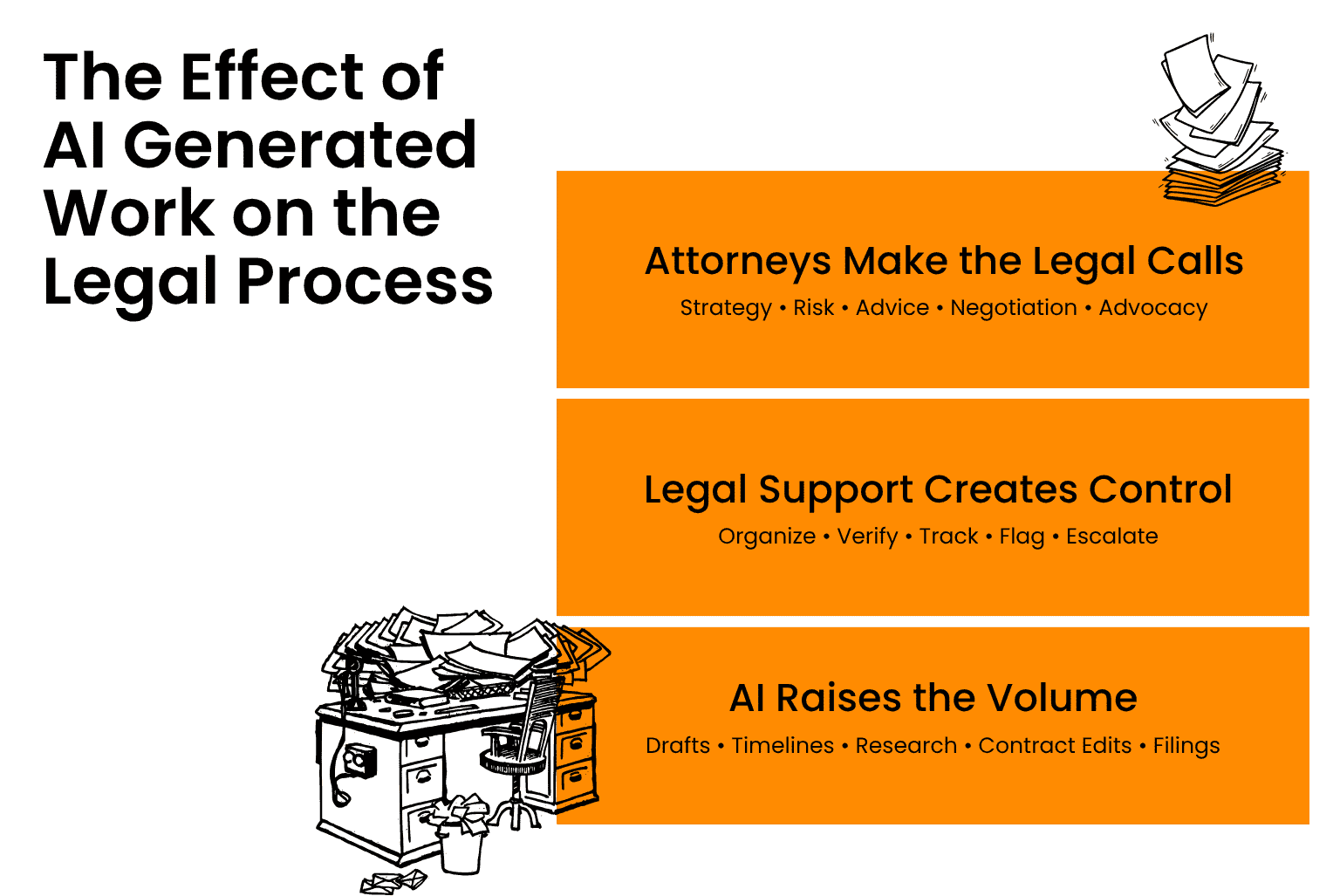
More Drafts, More Documents, More Cleanup
AI can help people start legal work, but it doesn’t automatically make that work accurate, complete, properly filed, or useful to the matter.
A client-provided timeline may skip the date that controls the claim. A demand letter may overstate the law. A research summary may rely on the wrong jurisdiction. A draft complaint may sound formal but miss a pleading requirement. A contract revision may look clean while changing the business risk in a way the client did not understand.
Courts are already watching the issue. The National Center for State Courts has noted both the benefits and risks of generative AI, including hallucinations, privacy concerns, cybersecurity, deskilling, and the effect of AI use by self-represented litigants. One concern is that AI could increase the volume and length of self-represented filings enough to overwhelm parts of the court system.
That pressure connects to a much larger access-to-justice issue. Stanford HAI reports that about 20 million civil cases are filed in the United States each year, and 75% involve at least one party without legal representation. AI may help people understand legal language and navigate court processes, but Stanford also warns about risks from hallucinations and bias.
What law firms really need to take away from this is the fact that more people will be able to produce legal materials before they talk to a lawyer.
That creates more intake work. More document review. More deadline checking. More file cleanup. More client communication. More decisions about what needs attorney attention and what can be handled by the right support person first.
Paralegals Will Carry More of the Review Burden
Paralegals may feel these changes first.
They’re often closest to the facts, documents, deadlines, exhibits, discovery materials, and practice-specific details that determine whether a matter is ready for attorney review. If more clients come in with AI-assisted drafts, timelines, research, and supporting documents, paralegals will be central to turning that material into something attorneys can actually use.
That may include:
- organizing client-provided documents
- checking timelines against records
- flagging missing information
- reviewing citations, exhibits, and attachments
- supporting pleadings and discovery
- tracking filing requirements and deadlines
- identifying inconsistencies before they waste attorney time
- preparing cleaner materials for attorney review
A strong paralegal makes attorney review faster, cleaner, and more focused.
Legal Assistants Keep Faster Workflows from Becoming Messy Workflows
Legal assistants will also become more important as AI speeds up communication and document production.
More drafts usually mean more versions. More client emails mean more follow-ups. More self-prepared materials mean more files to organize and review. More documents moving through the firm mean more chances for missed deadlines, messy correspondence, incomplete records, and administrative gaps.
Legal assistants help keep that from happening.
They manage calendars, filings, correspondence, document versions, scheduling, follow-up tasks, and client communication. They help keep the matter file clean. They protect the details attorneys may not see until something has already gone wrong.
A legal assistant who understands court deadlines, attorney preferences, confidentiality expectations, filing procedures, client communication, and legal software prevents bottlenecks from forming in the legal process.
As AI creates more drafts and forces faster communication, legal assistants help keep the chaos from spreading to other parts of the legal department.
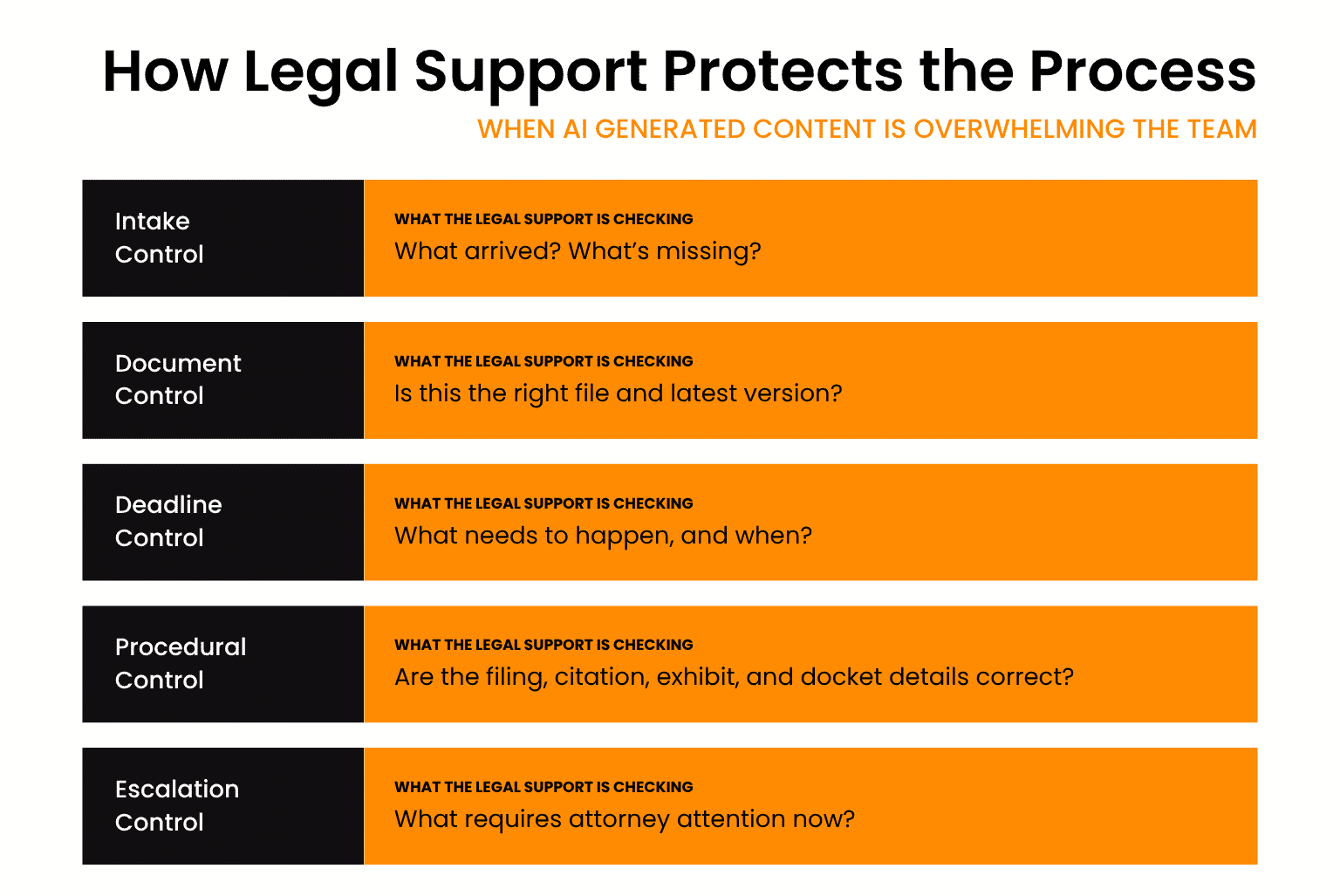
Litigation Support, Docketing, and eDiscovery Roles May Carry More Volume
Litigation practices may see some of the most immediate pressure.
If AI makes it easier for clients, opposing parties, or self-represented litigants to produce filings, discovery requests, exhibits, correspondence, and supporting materials, firms will need people who can manage the volume before it consumes attorney time.
That puts more importance on litigation support, docketing, and eDiscovery roles.
These professionals help organize document sets, manage deadlines, track docket activity, support discovery review, coordinate exhibits, and keep litigation teams from losing control of the details. In document-heavy matters, this is the work that lets attorneys focus on strategy, negotiation, hearings, and client advice.
If AI increases the amount of material entering a dispute, law firms need support teams that can keep the matter organized from the beginning.
Practice Support Roles Help Build the Handoff
Someone has to decide what happens when client-prepared or AI-assisted material enters the firm. Who reviews it first? What gets handled by a legal assistant? What belongs with a paralegal? Which parts need immediate attorney review? What can wait? What should be rejected, corrected, or sent back for more information?
In a smaller firm, that responsibility may sit with a senior paralegal, legal administrator, office manager, or practice manager. In a larger firm, it may involve legal operations, litigation support, knowledge management, or practice support.
The firm needs people who understand how work actually moves. Intake, file opening, document collection, deadline tracking, attorney review, client communication, billing, and closing are all connected. If AI changes the front end of that process, the handoff between roles needs to be redefined. A clear process is important with or without AI-influenced work.
Attorneys Still Play a Large Role
None of this means attorneys stop mattering.
Attorneys still own legal strategy, advocacy, negotiation, client advice, risk calls, and final review. In high-stakes matters, that work is still central to the process.
The problem is, attorneys shouldn’t be spending time on every disorganized file, every client-supplied draft, every missing document, every calendar issue, and every AI-generated summary no one else has reviewed. If this is what’s happening, you have a staffing issue that you need to take seriously.
If attorneys have to personally sort every client-supplied draft, rebuild every fact timeline, chase every missing document, check every filing detail, and clean up every AI-generated summary, the firm hasn’t improved efficiency. It’s moved lower-value work onto higher-cost time.
Strong legal support roles protect attorney time. They also protect client service because organized matters move faster, deadlines are easier to manage, and attorneys can spend more time on the legal decisions that matter most.
What Law Firms Should Hire for Now
Law firms should not respond to AI by adding vague phrases like “AI experience preferred” to every job description.
The better move is to define what each support role needs to handle as legal work changes.
| Role | What to Screen for Now |
| Paralegals | Practice-area knowledge, procedural accuracy, document organization, deadline awareness, citation and exhibit review, legal software fluency |
| Legal Assistants | Filing control, calendaring, correspondence, confidentiality, client communication, attorney support workflow |
| Litigation Support / eDiscovery | Document review workflows, data organization, docket awareness, discovery support, exhibit control |
| Practice Support / Legal Operations | Workflow design, handoff clarity, process improvement, staffing coordination |
| Attorneys | Supervision, escalation decisions, client explanation, risk assessment, ability to work effectively with support teams |
The smartest firms won’t treat legal support hiring as a secondary issue. They’ll define the work and process clearly, hire for law firm experience, and look for people who can keep matters moving when the volume and pace of information increases.
Final Takeaway
As AI changes what comes into the firm, law firms will need support professionals who can organize the work, protect deadlines, manage documents, and help attorneys stay focused on the work only they should own.
The firms that adapt best will not only invest in stronger technology. They will invest in the legal support roles that make the work manageable.
A paralegal role may require practice-area knowledge, court procedure, discovery experience, software fluency, attorney support experience, and the ability to organize complex matter details. A legal assistant role may require filing accuracy, docket awareness, confidentiality, client communication, and a working knowledge of how law firms operate.
Prime Legal supports law firms and corporate legal departments with legal staffing support, including paralegal recruitment, legal assistant recruiting, attorney recruiting, and more. When you need people who understand legal workflows and not just people who can fill a seat, Prime Legal can help you find the right candidate for the job. Contact our team today to see how we can help you prepare for the future!
