Blog - Legal Tech Is Becoming the Backbone of Legal Services (and Private Equity Knows It)

Private equity investment in legal services is no longer limited to back-office software or litigation support. The larger shift is that legal work is being reorganized into platforms: AI-assisted workflows, knowledge systems, eDiscovery infrastructure, compliance tools, law firm productivity software, and flexible legal talent models.
The legal industry is still a relationship-driven, judgment-heavy profession, but more of the work around legal judgment is becoming repeatable, measurable, and technology-enabled. Investors are following the parts of the market where legal work can scale.
Legal tech funding is another way PE firms are getting involved in the legal industry. PitchBook reported that legal tech VC funding rebounded to $2.6B across 164 deals in 2024, with legal operations attracting the most capital over the prior 12 months. At the same time, direct outside investment in traditional law firms remains constrained by professional rules, which is one reason investors often move into legal-adjacent infrastructure, managed services, technology platforms, and alternative structures instead.
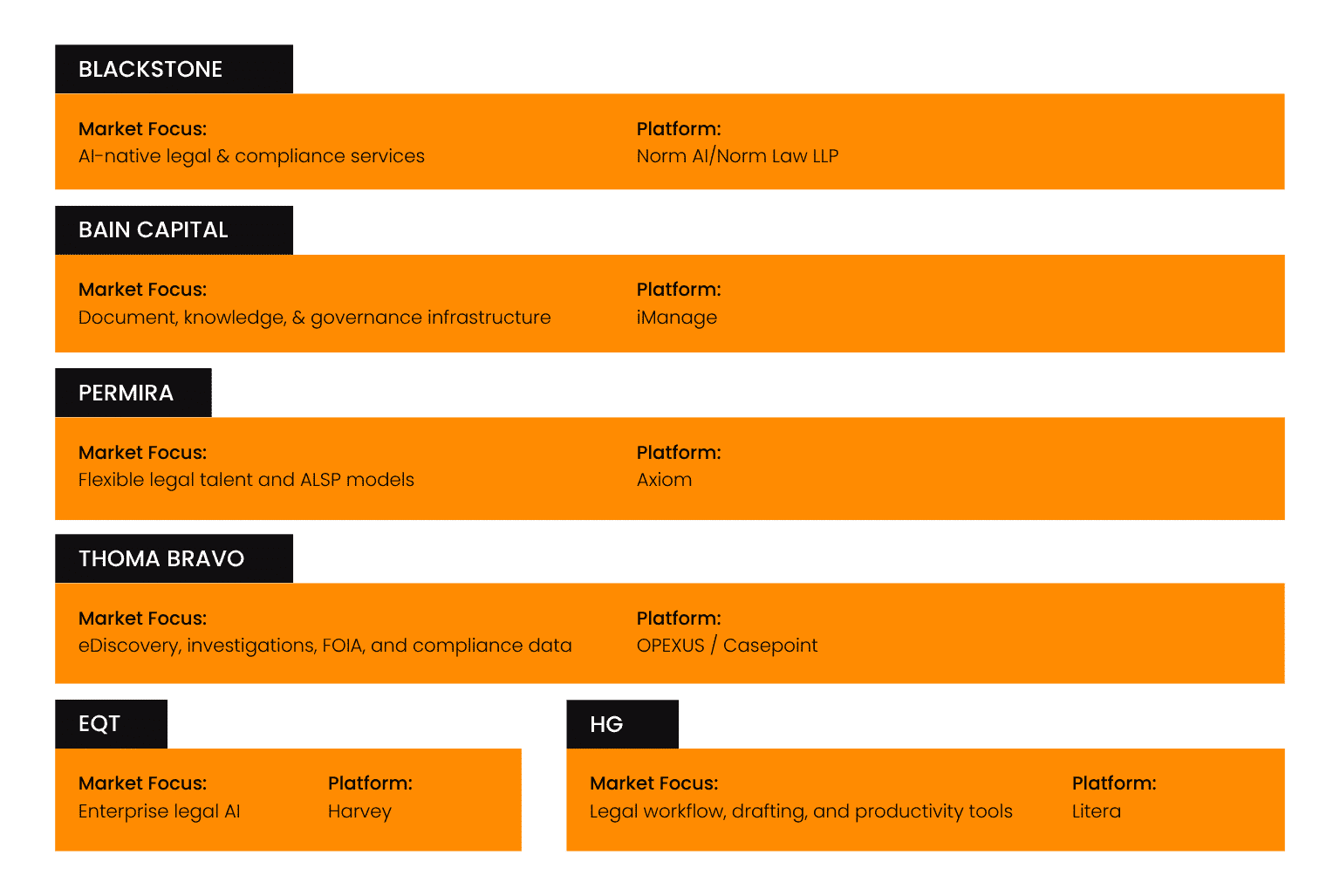 6 Major Private Equity Investors to Watch
-
Blackstone: AI-Native Legal and Compliance Services
Blackstone is the largest alternative asset manager in the world, with more than $1.3T in assets under management. Its legal-market activity is especially notable because it reaches beyond ordinary software investment and into the structure of AI-native legal service delivery.
In November 2025, Norm Ai announced a $50M investment from Blackstone and the launch of Norm Law LLP, described as an AI-native law firm initially focused on financial services clients. The announcement also said Blackstone and Norm Ai would collaborate on legal services for Blackstone’s use, building on Norm Ai deployments for regulated content review.
The signal is clear: PE interest in legal AI is not only about faster drafting or lower research costs. Blackstone’s investment points toward a model where legal AI, compliance processes, lawyers, and workflow design sit together. Norm Ai’s “Legal Engineering” approach, which combines a no-code AI platform with lawyers trained to convert legal workflows into AI agents, is a useful example of how legal expertise may be packaged differently as AI adoption matures.
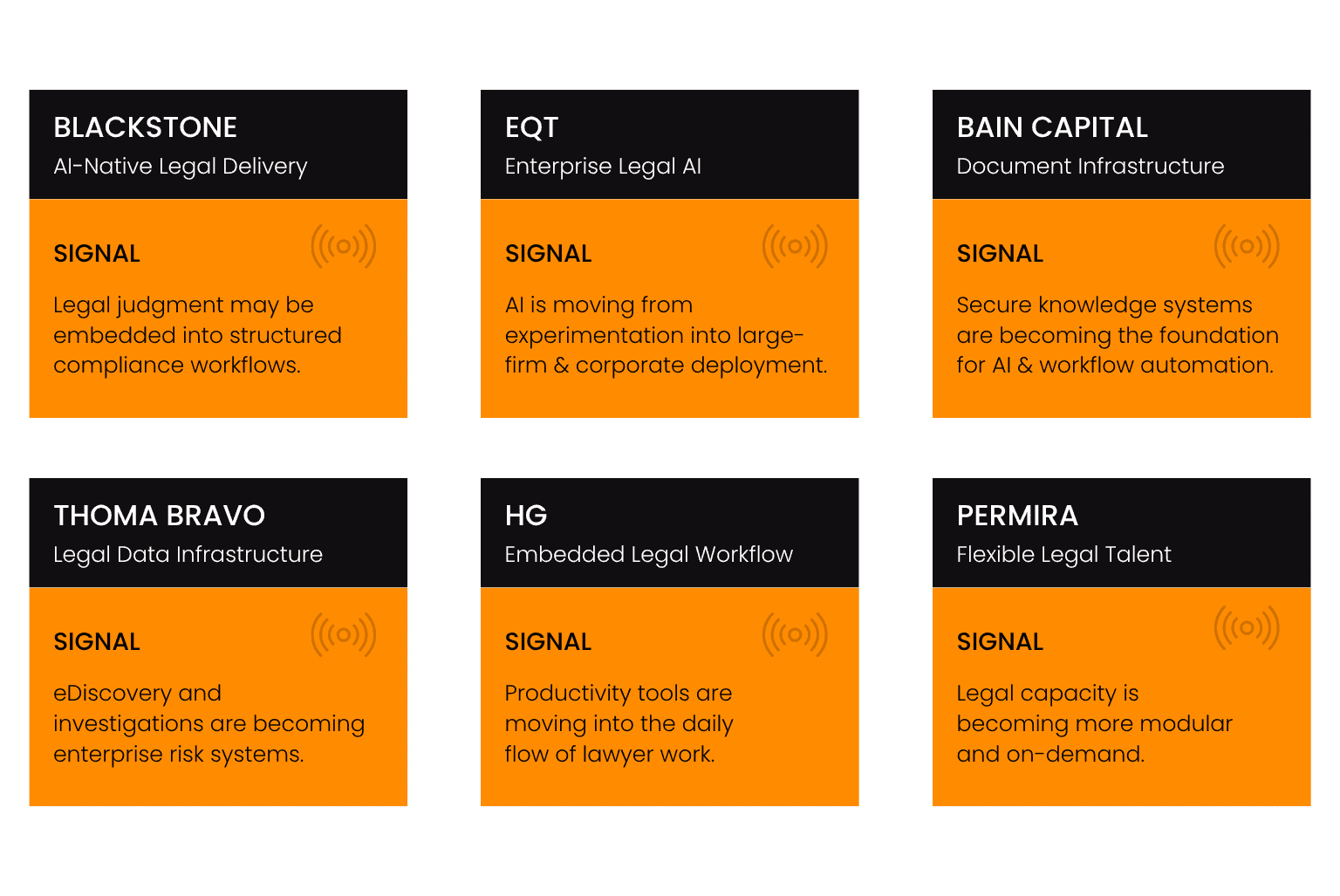
For law firms and corporate legal departments, this deal signals that legal judgment may need to be embedded into more structured systems.
-
EQT: Enterprise Legal AI for Law Firms and Legal Departments
EQT is another major global investment platform with visible exposure to legal AI. The firm reported €269B (~$364B) in total assets under management as of March 31, 2026.
EQT Growth made a €50M (~$67.7M) strategic investment in Harvey, a domain-specific AI platform for legal and professional services. Harvey said the investment would support international expansion and described its platform as serving global law firms and Fortune 500 enterprises through end-to-end workflow support.
This investment shows how quickly legal AI has moved from experimentation into enterprise deployment. Large firms and multinational legal departments need more than generic AI alone. They need systems that can handle complex permissions, regulated documents, cross-border work, multilingual matters, sensitive client data, and specialized practice workflows.
That creates a different adoption challenge. The software matters, but the work around the software matters too: training, supervision, workflow mapping, security review, and user trust. Legal AI becomes valuable when it is connected to how lawyers and legal teams actually work.
-
Bain Capital: Knowledge, Documents, and Governance Infrastructure
Bain Capital is one of the world’s largest private investment firms, with approximately $225B in assets under management. Its investment in iManage sits in one of the most important layers of legal infrastructure: documents, knowledge, governance, and secure collaboration.
Bain Capital Tech Opportunities made a strategic growth investment in iManage in 2023. The announcement described iManage as a cloud-based, AI-enabled knowledge work platform serving more than 4,000 legal, accounting, and financial services organizations in more than 65 countries.
This investment is intended to satisfy law firms’ needs for secure access to precedent, matter history, work product, permissions, and governance controls. Corporate legal departments need similar discipline around documents, records, contracts, and regulated information.
In that sense, document management is no longer a simple administrative function. It’s one of the foundations that determines whether AI, workflow automation, and knowledge reuse can work safely inside legal environments.
-
ThomaBravo: eDiscovery, Investigations, FOIA, and Data Compliance
Thoma Bravo describes itself as the world’s largest software-focused investment firm and says it manages more than $181B in assets. Its legal-market investment activity fits its broader focus on software, data, and workflow-heavy markets.
In 2025, OPEXUS and Casepoint announced a merger and majority investment from Thoma Bravo. OPEXUS provides government process management software, while Casepoint is focused on data discovery technology for litigation, investigations, and data compliance.
This tech investment targets a different part of the legal services stack than AI drafting or document management, but the investment logic is similar. eDiscovery, investigations, FOIA, and compliance response involve high data volumes, strict deadlines, defensibility concerns, security needs, and repeatable processes. Those qualities make the work attractive to software investors.
Law firms should not think of eDiscovery as just document review. It’s become part of enterprise risk infrastructure. The organizations that handle legal data well can respond faster, reduce operational friction, and manage sensitive information with greater consistency.
-
Hg: Law Firm Workflow, Drafting, Knowledge, and Productivity Platforms
Hg has approximately $110B in assets under management and focuses heavily on software and technology-enabled services. Its investment in Litera places it close to the everyday workflow of lawyers and law firm teams.
Hg’s Litera portfolio page describes the company as providing AI-driven tools across legal workflow and drafting, firm intelligence and knowledge management, and business development. Litera’s products are designed to work inside Microsoft 365 and other environments where lawyers already draft, review, and collaborate.
Hg’s investment points to a broader trend: legal software platforms are trying to unify more of the lawyer’s day, from creating documents to applying firm knowledge to supporting client growth. Legal technology becomes more valuable when it is embedded in the actual workstream, not sitting off to the side as another tool lawyers have to remember to open.
-
Permira: Flexible Legal Talent and Alternative Legal Services
Permira has more than €89B (~$120.5B) in committed capital across buyout, growth equity, and credit funds. Its investment in Axiom shows that private equity interest in legal services is not limited to software.
Axiom is a global on-demand legal talent platform. Permira’s portfolio page describes Axiom as helping companies access flexible legal talent across sectors and practice areas, with thousands of in-network lawyers and more than 1,000 clients.
This is one of the clearest examples of legal work becoming more modular. Corporate legal departments increasingly want access to experienced lawyers without always hiring permanently or sending every matter to outside counsel. Law firms also face volume spikes, client demands, attorney absences, and project-based needs that don’t always justify permanent hire.
The larger point is that people-based legal services can be turned into platforms too. Software may organize the work, but lawyers, paralegals, legal assistants, legal operations professionals, and litigation support teams still carry out the judgment, communication, review, and execution that legal work requires.
What These Investments Have in Common
The common thread among these investments is legal infrastructure.
Private equity is following the parts of legal work that can become more structured without losing the need for professional judgment. That includes:
- AI-assisted review, research, drafting, and compliance workflows
- Document and knowledge systems that organize firm intelligence
- eDiscovery and investigation platforms that manage high-volume legal data
- Law firm productivity tools embedded in daily attorney work
- Flexible legal talent models that help legal departments and firms manage changing capacity needs
This pattern also explains why legal talent remains central. Technology can streamline work, but it doesn’t remove the need for people who understand legal process, client expectations, confidentiality, privilege, deadlines, and practice-area nuance.
For law firms, that creates a staffing question as much as a technology question. If a firm adopts more advanced document, AI, or eDiscovery platforms, it may need attorneys who can supervise AI-assisted work, paralegals who can manage more structured matter processes, legal assistants who can protect workflow continuity, and temporary legal staff who can absorb short-term volume.
Working with a specialized legal recruiting firm like Prime Legal can help you narrow your searches to find the legal expertise you need with the skills that these new technologies are going to require.
What Law Firms Should Take Away
The main lesson for law firms is that legal tech should be evaluated as operating infrastructure, not as a side tool. A platform affects how matters move, how documents are created, how attorneys reuse knowledge, how clients receive updates, how support teams manage volume, and how risk is controlled.
That means adoption planning should include an adjusted talent acquisition strategy. A new AI or workflow system can expose gaps that were easier to ignore before: inconsistent document practices, unclear matter ownership, thin paralegal coverage, overextended attorneys, or support staff who have no bandwidth to help standardize processes.
Firms should also think more carefully about which needs are permanent and which are temporary. A sustained practice-area expansion may call for a lateral attorney search. A litigation spike may require temporary paralegal or legal assistant support. A system migration may require short-term legal operations or document support. A corporate client with growing internal legal needs may need contract in-house counsel before committing to a permanent hire.
 Other Private Equity Investors Worth Watching
The six firms above aren’t the only investors active in legal services and legal technology. Francisco Partners, Warburg Pincus, Stone Point, Aquiline, FTV Capital, Lightyear, and others have also been connected to legal software, legal operations, eDiscovery, document systems, payments, and practice-management infrastructure.
The broader activity here reinforces the same conclusion. PE investment isn’t chasing one narrow legal tech category. It’s moving across the operating system of legal work: the tools that store knowledge, the systems that manage data, the platforms that support lawyers, and the talent models that help legal teams scale.
Final Takeaway: PE Is Following the Parts of Legal Work That Can Scale
Private equity’s growing interest in legal services and legal tech gives us a glimpse into the changes coming for legal work.
Blackstone, EQT, Bain Capital, Thoma Bravo, Hg, and Permira are investing in different parts of the legal market, but their investments point in the same direction. Legal work is becoming more platform-driven, more data-heavy, more workflow-oriented, and more dependent on specialized talent that can operate inside modern legal systems.
The use of technology is going to matter in the coming years. Law firms and corporate legal departments need to determine whether they have the right systems, processes, and people to use that technology well.
For legal teams that need specialized legal talent to fill these skill gaps, Prime Legal offers specialized legal recruiting services built around the roles and expectations of the legal market. Reach out to our team to discuss the options we have available to assist your team.
