Blog - How to Stand Out in a Law Firm Interview When You Have 48 Hours to Prepare

TL;DR: Partner interviews are not really about whether you’re smart or qualified. Those assumptions are usually already in place. What partners are judging is whether they can trust you with ambiguity, client consequences, and decisions that carry risk.
The strongest candidates come across as clear, calm, and realistic. They answer directly, show sound judgment, acknowledge uncertainty when needed, and explain how they weigh competing priorities like risk, cost, timing, and supervision. Over-rehearsed stories, overly long answers, vague “impressive” examples, and negative comments about past employers tend to hurt more than help.
In the final stretch before the interview, focus on a few real examples where judgment mattered, research your interviewers, prepare thoughtful questions that show genuine interest, and present yourself professionally. The goal is not to perform. It is to make partners feel confident that you would handle clients, pressure, and responsibility well.
What Partners Are Actually Deciding
Partners are not deciding whether a candidate is smart, qualified, or hardworking. Those assumptions are already baked in.
They are deciding whether the candidate can be trusted with incomplete information, real clients, and consequences that cannot be easily undone. In partner interviews, hiring is framed as risk management. Every answer is subconsciously weighed against a simple internal question: What breaks if this person is wrong?
Candidates who approach interviews as evaluations of merit often overshoot. Partners respond better to candidates who implicitly show restraint, awareness of stakes, and respect for uncertainty. The interview is less about proving capability and more about demonstrating sound judgment under ambiguity.
How Partners Interpret Answers
Partners don’t listen neutrally. They filter.
A direct answer followed by a pause signals confidence and control. A long answer that circles the point suggests insecurity or poor client communication. When a partner interrupts, they are not being rude. They are testing whether the candidate can adjust in real time.
Hesitation is not fatal. Evasion is. A candidate who acknowledges uncertainty and explains how it was handled often scores higher than one who tries to smooth over gaps.
After the interview, partners rarely quote answers verbatim. They summarize impressions. Those impressions are shaped by how the candidate handles pressure, interruption, and silence.
What to Emphasize in Every Answer
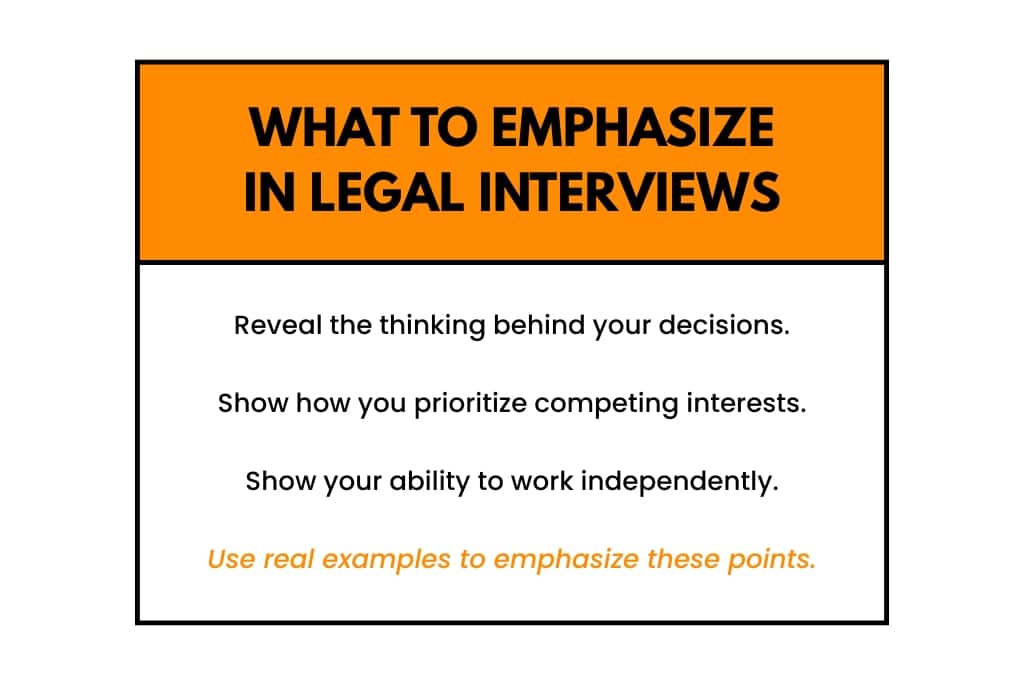
Strong answers reveal thinking, not performance.
Partners want to see how candidates prioritize when multiple interests compete. This includes legal risk, client cost, timing, and internal expectations. Answers that show awareness of these tensions feel realistic.
Supervision is another subtext. Partners assess whether the candidate can operate independently within reasonable bounds. A candidate who escalates every decision reads as inefficient. One who never escalates reads as dangerous.
Each answer should leave the partner with a sense of how the candidate would behave without instructions. Use real examples from your experiences to show your capabilities in these areas.
How to Talk About Experience Without Sounding Rehearsed
Rehearsed answers are easy to spot. They sound smooth and say very little.
Instead of narrating an entire matter, candidates should isolate a moment where a decision mattered. What information was missing? What options were considered? What risks were accepted?
Avoid dramatic framing. Partners are skeptical of stories that resolve too cleanly. They prefer understated explanations that acknowledge tradeoffs and limitations.
A measured tone suggests credibility. Over-polished storytelling suggests performance.
Business Awareness That Actually Registers
Business awareness only matters when it is specific. Partners respond to candidates who understand how legal work affects client behavior. This includes billing sensitivity, responsiveness expectations, and how delays or surprises erode trust.
Candidates do not need to sound commercial. They need to sound aware. Mentioning how a discovery approach reduced unnecessary cost or how deal pacing affected client confidence signals real exposure.
General market commentary rarely moves the needle. Practical awareness does.
Communication Mistakes That Quietly End Interviews
Most candidates are eliminated quietly. Partners rarely confront candidates about weak communication. Instead, they note concerns privately and move on. Common issues include answering adjacent questions, over-contextualizing, or narrating process instead of decisions.
Filling silence is also a frequent mistake. Silence after a clear answer often signals confidence. Talking past the point signals anxiety.
Partners imagine how candidates will communicate with clients. Interviews are proxies for that assessment.
Coachability Without Undercutting Authority
Coachability is not about obedience. Partners look for candidates who can absorb feedback and still own outcomes. A candidate who frames improvement as something imposed from above appears dependent. One who frames adjustment as a personal decision appears scalable.
When discussing feedback, candidates should focus on what changed in their approach, not who corrected them. This signals internalization rather than compliance.
Partners invest time in people who improve without constant intervention.
Culture Signals That Matter More Than Personality
Culture is evaluated through behavior, not likability. Partners assess whether a candidate understands how work moves through the firm. Respect for staff, responsiveness, and collaboration are assumed. Candidates who reference these organically show situational awareness.
Complaints about prior firms or colleagues are red flags, even when subtle. Partners infer how the candidate will behave under stress.
When discussing issues like leaving your current position, it’s important to never speak negatively about people in an unprofessional way. While you may be leaving because of a negative work environment, the issue should be talked about in a professional manner that doesn’t talk down on anyone. Prime Legal’s recruiters have found this to be one of the main reasons people get removed from the interview process.
What to Do in the Final 48 Hours
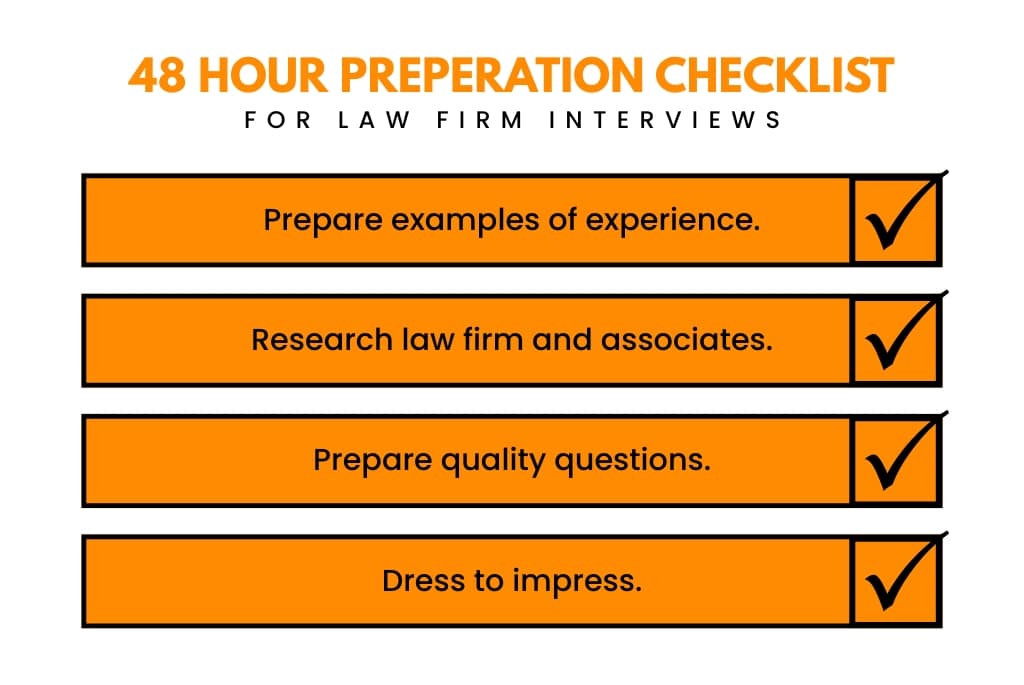
Prepare Examples of Experience
Preparation should be selective. Candidates should identify a small number of matters in their experience where real judgment was exercised. They should clarify what was unclear at the time, what risks were weighed, and how decisions were communicated.
Practicing concise answers matters more than rehearsing stories. Candidates should practice stopping after answering, not continuing until interrupted.
Anything that sounds impressive but vague should be cut.
Do Your Research
It can be helpful to research the individuals that you’ll be interviewing with. Through your research you’ll be able to make connections between the individuals you’re talking to and the experiences that you’ve had allowing you to frame your answers in a way that relates to the interviewer. Having this extra preparation often allows candidates to feel more relaxed and confident when they get to the interview.
Be Prepared With Questions
Often times the candidate that stands out is the candidate that shows that they have the most interest and passion for the position. How do you show your interest in an interview? You ask questions.
These questions should not be about pay. Better questions revolve around topics like:
- Personal experience of the people interviewing you
- Company culture
- Processes in place
You want to show interest in the operations of the company, not just the compensation you’ll receive.
Dress to Impress
Your appearance is one of the first impressions that the interviewers will have of you. Make a good first impression. Do not show up in casual or business casual clothing. Show up in clean, professional clothing that leaves a good impression.
Final Reality Check
Most candidates fail interviews by sounding capable but interchangeable.
Partners remember candidates who are clear, restrained, and realistic about uncertainty. They trust candidates who do not oversell and do not hide tradeoffs.
Prepare by getting to know your audience, framing your experiences in a way that your audience can relate to, and coming up with questions that show your genuine interest in the role.
With this preparation, you can walk into your interview with confidence and clarity that will set you apart from other candidates.
