Blog - Legal Job Ad Tips to Attract Top Talent

Most legal job ads don’t lose candidates because the role is bad. They lose candidates because the job posting is hard to evaluate quickly.
A lawyer scanning a job board is rapidly gathering information on multiple companies and roles. If the ad makes them guess about level, scope, compensation, or workload reality, they move on. They don’t send an email for clarification. They don’t “circle back.” They close the tab. A lack of clarity leads to a loss of potential candidates.
Your job ads are simple recruiting tools that are cheap to improve and easy to measure performance. You don’t need to be a poet to write a good job posting, you just need to focus on a few small things that will result in fewer wasted screenings and more qualified candidate conversations.
What A Strong Legal Job Ad Is Supposed to Do
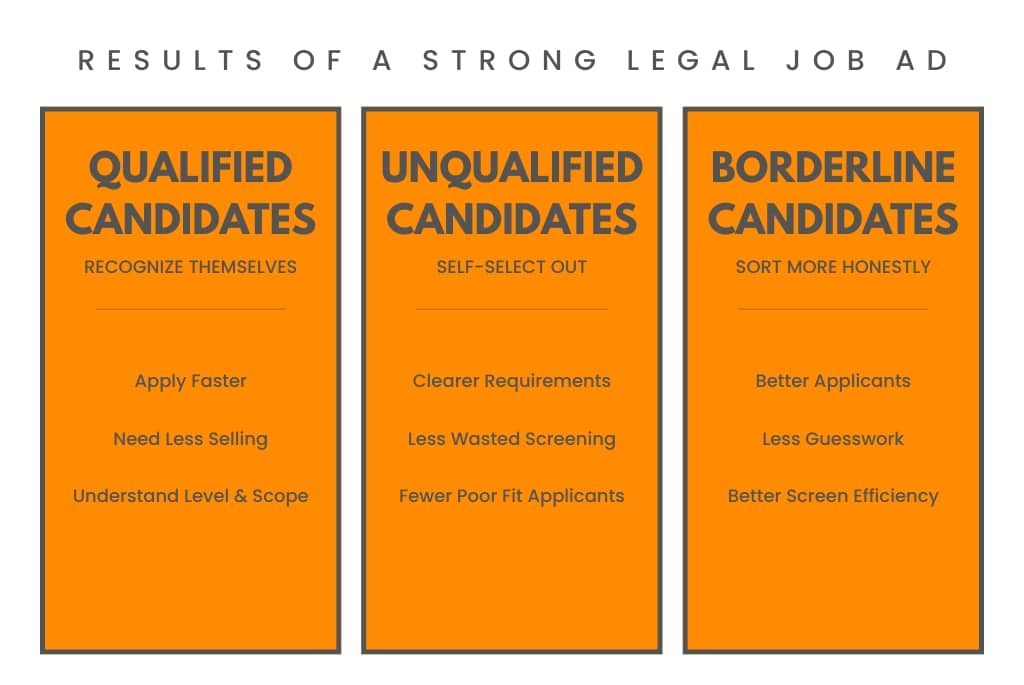
A job ad is a filter and a self-selection tool. When it works, three things happen:
- Qualified candidates recognize themselves and apply without needing a recruiter to sell them.
- Unqualified candidates talk themselves out of it because the requirements are plain.
- Borderline candidates self-sort into “worth a call” or “not a fit” because the scope is concrete.
That improves recruiting outcomes you can track:
- Apply Rate: applications divided by views
- Qualified Applicant Rate: applicants who meet the true bar for the role
- Time To Shortlist: days from posting to a credible slate
- Screen Pass Rate: screens that advance to hiring manager
Even without those metrics you can gain insight into the success of your job ad. If a posting is getting views but not applications, the top section is unclear. If it’s getting applications but very few pass screens, the requirements and scope are too vague.
Start With Scope So Candidates Can Self-Qualify Fast
Most job ads waste the first paragraph describing the firm. Candidates don’t need that yet. They need to know what they would actually do.
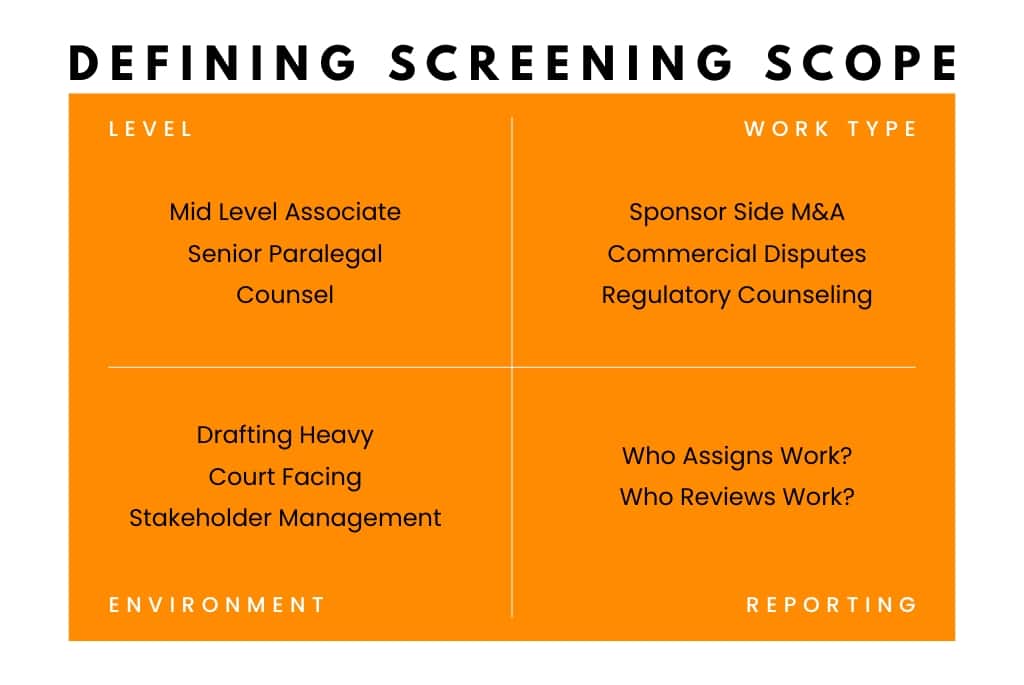
For legal job ads, that clarity starts with a scope statement that fits on one screen:
- Level: mid-level associate, counsel, senior paralegal
- Work type: sponsor-side M&A, commercial disputes, regulatory counseling
- Center of gravity: drafting-heavy, court-facing, stakeholder management
- Reporting reality: who assigns work and who reviews it
A candidate shouldn’t have to infer whether they will draft or just markup. They shouldn’t have to guess whether they will take depositions or only prep others.
Two sentences can do a lot:
“Mid-level litigation associate (3-6 years) to own written discovery and draft dispositive motions in commercial matters. Direct partner oversight, regular client exposure, and responsibility for deposition prep and outlines.”
This is the information that people are looking for.
Why Salary Ranges Pull More Applicants and How to Keep Quality High
Pay transparency is rising quickly in the US. Indeed Hiring Lab has documented major growth in salary information appearing in job postings in recent years.
Indeed has also reported that postings with employer-provided salary information receive about 3.8x more applications than those without.
Pay ranges work best when the ad explains what the range assumes.
A compensation section that pulls in better candidates usually includes:
- Base range
- Leveling note tied to class year or comparable experience
- Variable components that matter in legal (bonus, billable bonus, origination credit if relevant)
- Any non-negotiables (in-office expectations, travel, bar admission requirements)
A clean version looks like this:
“Base range $210,000 to $265,000 depending on class year and deal leadership experience. Bonuses tied to hours and firm performance.”
That reduces noise. It also saves time on the phone, because candidates don’t have to dance around compensation to learn whether the move is realistic.
How To Write Requirements Without Shrinking the Applicant Pool
Most legal job ads unintentionally treat their wish lists like their requirements.
According to an Indeed Insights study, employers said that job seekers only need to have about 70% of the requirements listed to be considered for the role. However, about a third of candidates have opted out of an open role due to not meeting all of the requirements. That extra 30% of requirements that you don’t necessarily need could be pushing away candidates that are actually qualified.
In legal recruiting, this becomes painful because many strong candidates are “close enough” to succeed: adjacent practice experience, smaller-platform training, heavy reps in one transaction type but not every type.
The solution? Use two tiers and keep the candidates honest:
Required should be truly required: bar status, baseline years, core work exposure.
Preferred should capture the advantage of additional skills/experience without pretending that it’s absolutely necessary.
Then write requirements in verifiable terms. “Excellent drafting” is not verifiable. “Has drafted purchase agreements and negotiated key provisions directly with counterparties” is. This helps the candidate self-assess and helps you screen without guesswork.
How To Reduce Drop-Off with Better Skimmability
People scan online. They scan because they’re busy, not because they’re careless.
The Ladders eye-tracking study found recruiters spend an average of 7.4 seconds on an initial resume review. That’s not a job-ad study, but it does support the broader point: in recruiting workflows, the first pass is fast.
Legal job ads can be longer than average because legal candidates are managing risk. They will read details that reduce uncertainty. They won’t read walls of useless text. A structure that consistently performs well in the legal industry looks like this:
- Role Summary (one screen)
- What the Work Looks Like (responsibilities written as outcomes)
- Required vs Preferred Skills/Experience
- Compensation and Work Model
- How the Team Operates (staffing, supervision, feedback cadence)
- Interview Process (steps and what to submit)
That structure is not a style choice; it’s a way to prevent drop-off.
How Employer Branding in Legal Recruiting Works Inside a Job Ad
Candidates research employers. Glassdoor reports that 83% of job seekers are likely to research company reviews and ratings before applying. That’s why “collaborative culture” doesn’t move the needle. Everyone says it but lawyers look for real signals that the practice runs with discipline.
To truly show the candidate what your company values, include information on:
- Staffing: how work gets assigned and whether it’s predictable
- Supervision: who reviews drafts and how feedback is delivered
- Exposure: whether associates get client contact or stay behind layers
- Hybrid reality: days, flexibility, and what happens during crunch time
- Advancement: how progression is evaluated and what “good” looks like
For example: “Weekly staffing meeting assigns drafting ownership by matter stage. Associates receive written feedback on major drafts within 48 hours.”
That text gives candidates real insights into the operations of the company as opposed to a generic culture statement that may or may not be true.
The ABA’s lawyer well-being resources are a reminder that expectations and workload management matter. The job ad is one of the few places you can reduce skepticism early by being clear about how the practice runs.
Translate The Candidate’s Decision Math into Credible Copy
Lawyers are rarely asking, “Can I do this?” They’re asking, “Is this worth leaving for?”
That decision includes compensation, but also:
- Will the work be high quality and consistent?
- Will the workflow be managed or chaotic?
- Will the role build skills or narrow them?
- Will advancement be defined or political?
A job ad doesn’t need to promise the moon. It needs to answer those questions with facts.
A counsel posting can say: “This role owns the commercial template library and escalation rules.” That signals influence and stability.
A law firm posting can say: “Partnership consideration begins in year eight, with written criteria reviewed annually.” That signals structure.
Those are not marketing claims. They are operational statements candidates can trust.
Best Legal Job Posting Examples with Copy That Pulls Its Weight
Litigation Associate
“Mid-level litigation associate (3-6 years) to own written discovery and draft motions on commercial disputes. Responsible for deposition prep and regular client contact. Base salary range $175k – $230k depending on years of experience and courtroom exposure, plus bonuses. Hybrid with two in-office days expected.”
This works because it answers level, scope, compensation, and the work model without any fluff.
In-House Commercial Counsel
“Commercial counsel supporting sales and procurement on customer and vendor contracts. Own negotiation strategy for mid-market agreements, maintain templates, and train stakeholders quarterly. Base salary range $160k – $200k plus bonuses, dependent on years of experience and deal complexity.”
This works because it shows ownership and how the role fits the business.
Legal Job Ads Checklist Recruiters Can Use Tomorrow
A posting is ready when it answers these quickly:
- What is the level and practice focus?
- What does the work look like in real terms?
- What does the compensation range assume?
- What is required versus preferred?
- What is the interview process and expected timeline?
- What operating facts prove this team runs well?
If any of those are missing, the posting is asking candidates to make a guess. Candidates rarely want to spend time playing guessing games in a market where they have options.
Conclusion
Legal job ads attract better talent when they reduce guesswork early. A clear scope beats a narrative of firm history. Salary ranges speed up decisions and screen candidates for fit. Tight requirements preserve applicant quality. Employer branding works when it reads like the operating manual of a practice group.
Your firm doesn’t need a “better story.” It needs postings that let the right candidates understand the job quickly and trust what they’re reading.
A simple next step is to rewrite one posting, keep the role constant, and track your apply rate and screen pass rate for two weeks. If done right, you should see these small changes make a big difference in the quality of candidates that apply to your roles.
