Blog - Corporate Paralegal Career Path: From Legal Support to Senior Roles

TL;DR
A corporate paralegal career usually starts with legal support tasks, but advancement depends on moving into workflow ownership. As you gain experience, your value comes from managing contracts, corporate records, governance materials, compliance deadlines, entity information, and legal technology with enough judgment to know when attorney review is needed.
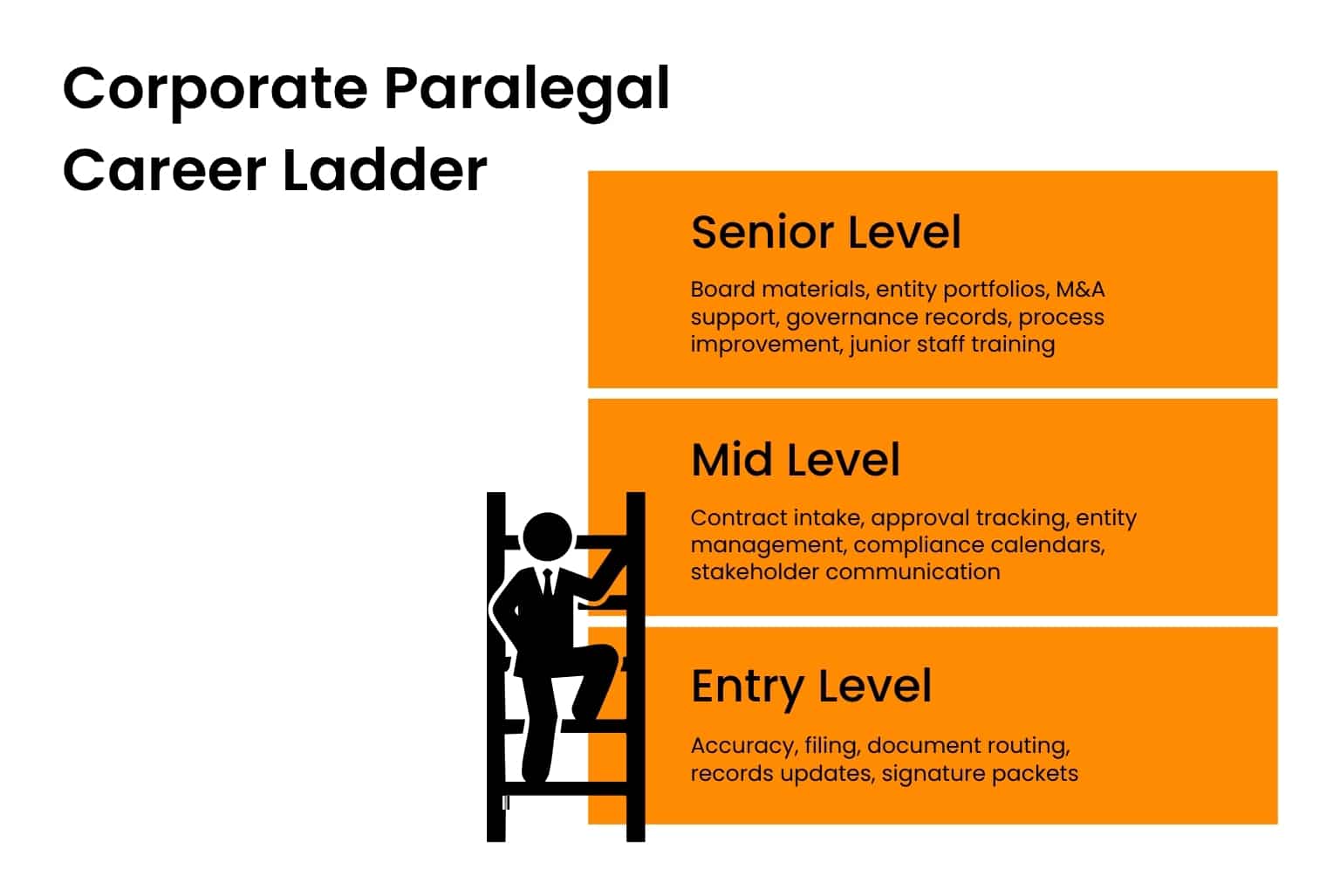
Entry-level roles build accuracy and reliability, mid-level roles require stronger ownership and communication, and senior roles often involve higher-risk workflows, process improvement, and cross-functional legal support.
The strongest corporate paralegals show that they can reduce attorney rework, keep business-facing legal matters organized, and support corporate legal teams beyond basic administrative tasks.
What Makes Corporate Paralegal Work Different
Corporate paralegals support legal work connected to how businesses operate. Instead of focusing primarily on pleadings, discovery, court filings, or trial preparation, you may work with contracts, corporate records, board materials, entity maintenance, compliance calendars, due diligence files, financing documents, regulatory forms, and internal legal requests.
That business-facing environment changes the way the paralegal role functions day to day. You’re often working with attorneys, executives, finance teams, HR, procurement, sales, outside counsel, registered agents, and vendors.
Corporate Work Is Business-Facing
Corporate legal work usually sits close to company operations. That means your work may affect how quickly a contract gets signed, whether an entity remains in good standing, whether board materials are accurate, or whether a business team has the legal support it needs to move forward.
Common corporate paralegal responsibilities may include:
- Supporting contract review and execution workflows
- Maintaining corporate records and entity information
- Preparing board consents, resolutions, and governance materials
- Tracking compliance deadlines and filings
- Organizing due diligence materials for transactions
- Coordinating with outside counsel, registered agents, and internal teams
A missed detail may not lead to a missed court deadline, but it can still create real risk. An unsigned consent, outdated entity record, missed renewal date, incomplete diligence folder, or poorly tracked contract approval can slow a transaction, frustrate a business team, or force attorneys to spend time rebuilding work that should have been controlled earlier.
 Entry-Level Corporate Paralegal Responsibilities
An entry-level corporate paralegal role often begins with organization, accuracy, and follow-through. You may maintain electronic files, update corporate records, format documents, prepare signature packets, route contracts for approval, assist with closing binders, track matter status, and help attorneys gather information from business teams.
The Foundation Is Accuracy
The work may look administrative at first, but it builds the foundation for more substantive responsibility. If you can’t control names, dates, versions, folders, signatures, and deadlines, attorneys won’t trust you with higher-risk work.
At this stage, your responsibilities may include:
- Organizing corporate files and legal documents
- Routing contracts for review or signature
- Updating spreadsheets, trackers, or entity records
- Preparing standard forms and document templates
- Assisting with closing binders or transaction files
- Monitoring basic deadlines and follow-up items
Corporate legal teams depend on clean records because those records may be reviewed later during audits, financings, acquisitions, disputes, or regulatory inquiries.
What You Should Learn Early
At this stage, your goal is to become dependable in the details. You should learn the difference between a contract draft and an executed agreement, why entity names need to match official records, how approval chains work, and how corporate documents are stored. You’re also learning how attorneys think about risk, even when you’re not making legal decisions yourself.
Mid-Level Corporate Paralegal Responsibilities
Mid-level corporate paralegal work is where the career path starts to separate from general administrative support. At this stage, you’re not only completing assignments; you’re often managing pieces of the workflow.
You may handle contract intake, track approvals, coordinate signatures, maintain contract databases, prepare board consents, update entity management systems, manage annual report calendars, support due diligence requests, and communicate directly with internal stakeholders.
The Difference Is Ownership
A junior employee may upload documents into a folder. A mid-level corporate paralegal understands whether the folder is complete, whether the right version was signed, whether the approval path was followed, whether the naming convention makes the document findable, and whether a missing item needs attorney attention.
Mid-level work may include:
- Managing contract intake and approval tracking
- Coordinating signatures and executed agreements
- Maintaining contract or entity management databases
- Preparing governance documents under attorney supervision
- Supporting due diligence requests
- Tracking annual reports, filings, and compliance deadlines
- Communicating with internal business teams about missing information
The work you do becomes more valuable because you’re helping the legal team keep recurring work under control without having to be managed constantly.
Communication Becomes Part of the Job
This is also where communication becomes more important. You may need to ask a sales manager for missing contract information, remind an executive about a signature, coordinate with outside counsel on filing status, or explain to a business team why a document can’t move forward yet.
You’re not giving legal advice, but you are helping the legal process move in a controlled way.
Senior Corporate Paralegal Responsibilities
A senior corporate paralegal is trusted with more complex, recurring, and business-sensitive work. You may manage an entity portfolio, prepare board and committee materials, coordinate corporate filings across jurisdictions, support mergers and acquisitions, maintain governance records, oversee contract administration, train junior staff, improve templates, and help attorneys keep major workflows on track.
Senior Paralegals Handle Higher-Risk Workflows
Senior-level work requires stronger judgment. You need to recognize when something is routine and when it’s not. A missing signature, inconsistent party name, unusual approval request, expired authorization, incomplete officer list, or urgent contract change may need to be escalated.
Your value at this level is knowing enough about the workflow to protect accuracy, timing, and visibility.
Senior corporate paralegal responsibilities may include:
- Managing complex entity portfolios
- Preparing board and committee materials
- Coordinating corporate filings across multiple jurisdictions
- Supporting mergers, acquisitions, or financing transactions
- Maintaining governance records and corporate books
- Training junior legal support staff
- Improving templates, trackers, and internal processes
- Coordinating with outside counsel and vendors
Technology Fluency Becomes Harder to Avoid
Technology also becomes more important as you move up. Corporate paralegals may work in contract lifecycle management systems, document management platforms, entity management tools, e-signature platforms, matter management systems, and spreadsheets that track legal obligations.
A senior paralegal doesn’t need to be a systems engineer, but you should understand how legal data is entered, maintained, searched, and trusted.
This is one reason corporate paralegal roles can become strong stepping stones into legal operations. The work naturally overlaps with process improvement, reporting, vendor coordination, template management, and system adoption.
Where the Corporate Paralegal Career Path Can Lead
Corporate paralegal advancement doesn’t follow one fixed route. Some people build long careers as senior corporate paralegals in law firms or corporate legal departments. Others use the experience to move into related roles.
Common Next-Step Roles
Depending on your skills and interests, a corporate paralegal background may lead toward roles such as:
- Senior Corporate Paralegal
- Contracts Manager
- Legal Operations Specialist
- Corporate Governance Specialist
- Compliance Coordinator
- Entity Management Specialist
- Legal Project Coordinator
- Assistant Corporate Secretary support role
The right path depends on what kind of work you enjoy. If you like negotiation support and business coordination, contracts may be a strong direction. If you like records, board materials, and entity structure, governance may fit better. If you like systems, reporting, and process improvement, legal operations may be the better long-term move.
How to Position Yourself for Growth
If you want to move forward, your resume should show ownership instead of only listing tasks. Employers want to know what you can handle without creating extra work for the people who manage you. They also want to know whether you understand the systems, deadlines, communication habits, and judgment calls that keep corporate legal work moving.
 Replace Task Lists with Ownership Statements
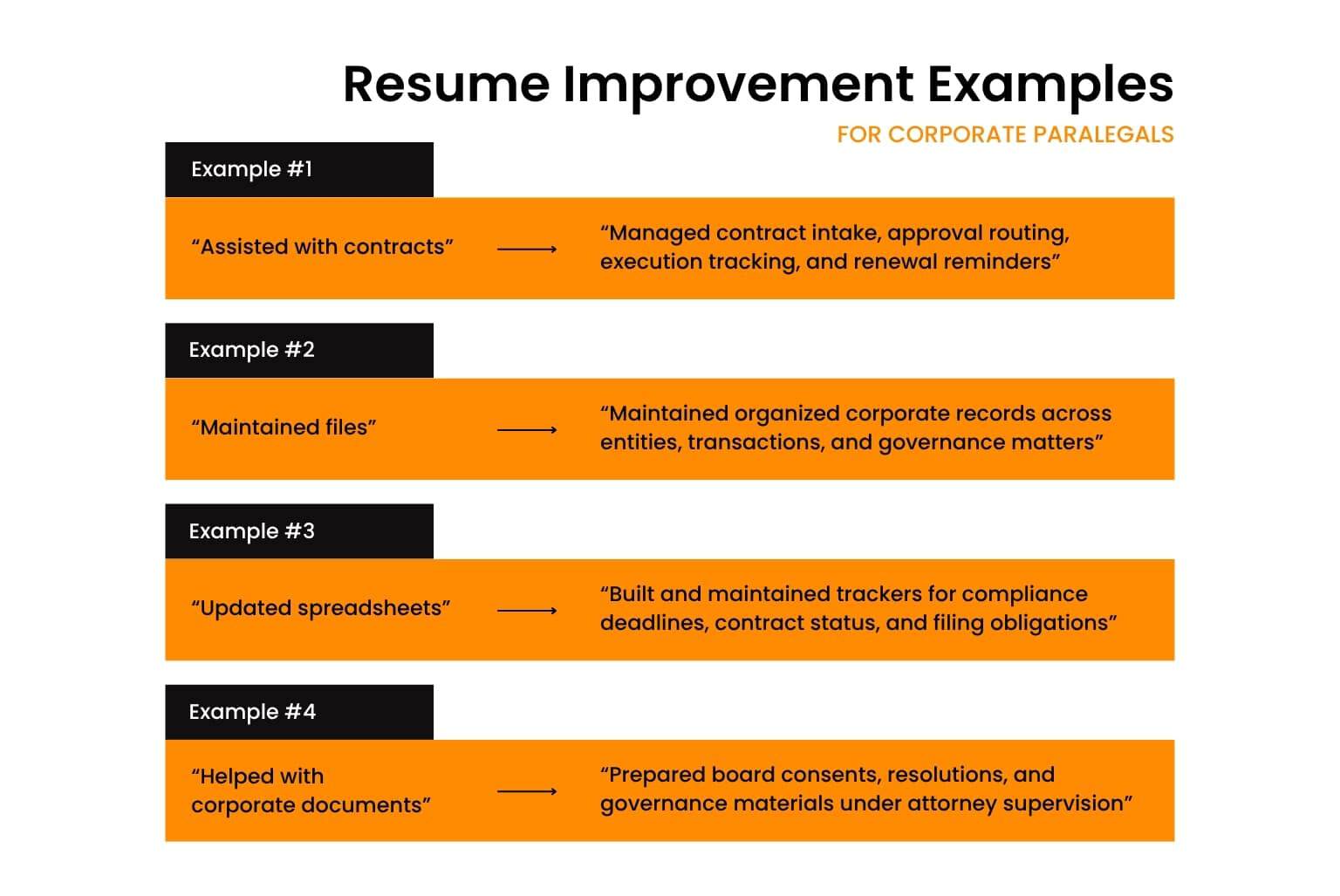
Weak resume language usually sounds passive:
- Assisted with contracts
- Maintained files
- Updated spreadsheets
- Helped with corporate documents
Stronger resume language shows responsibility:
- Managed contract intake, approval routing, execution tracking, and renewal reminders
- Maintained entity records across multiple jurisdictions
- Prepared board consents, resolutions, and governance materials under attorney supervision
- Coordinated due diligence requests for corporate transactions
- Built trackers for compliance deadlines, contract status, or governance filings
The stronger examples show what you owned, what kind of legal workflow you supported, and how your work helped attorneys or business teams.
Build From Legal Assistant Work into Corporate Paralegal Work
If you’re currently in a legal assistant role, the path into corporate paralegal work may begin by building stronger document control, contract support, and business communication experience.
Your chances of progressing into corporate paralegal work increase when stop simply completing tasks and start to understand how legal information moves through a business.
The Bottom Line
A corporate paralegal career grows when you move from task completion to workflow ownership. Entry-level work teaches accuracy. Mid-level work builds responsibility. Senior-level work depends on judgment, legal technology fluency, business communication, and the ability to manage sensitive corporate legal processes under attorney supervision.
If you’re exploring your next legal support role, check Prime Legal’s job board to find opportunities that fit your experience and career direction.
If you’re hiring and need help with your search, reach out to Prime Legal’s team to see how we can assist you.
