Blog - The Niche Skills Probate and Trust & Estate Paralegals Need (and How to Hire for Them)
So, you’re looking for a probate or trust and estate paralegal. You’ve been posting job ads for months, and nothing seems to be working quite right. You’re getting applications, but not from candidates with the qualifications you actually need. At some point, you start wondering whether the job ad is wrong, the compensation is wrong, the market is too thin, or the right candidates just aren’t looking.
The answer is usually some combination of all four.
Candidates may have legal experience. They may have drafted documents, managed files, spoken with clients, and supported attorneys across several practice areas. But probate and trust and estate work often asks for a narrower mix of skills: fiduciary records, asset coordination, beneficiary communication, court procedure, tax-adjacent documentation, and the judgment to work with families and high-net-worth clients during sensitive matters.
The problem in many of these searches is not that your job ads aren’t being seen. It’s that you’re searching for someone with a highly desirable niche skillset in a competitive legal market.
For roles like these, your talent acquisition strategy needs to be more specific than it would be for a general paralegal role. Skills and responsibilities need to be clearly defined. Compensation ranges should be based on benchmark data from roles that actually match the work. And in many cases, firms need to look beyond job boards to reach candidates who already have probate, administration, fiduciary, or trust and estate experience.
A legal recruiter may be a better option when the search depends on access to passive candidates and a clear understanding of what the role actually requires.
Probate and Trust & Estate Hiring Is Really Several Different Searches
The U.S. Bureau of Labor Statistics describes paralegals and legal assistants as supporting lawyers through work such as maintaining and organizing files, conducting legal research, and drafting documents. BLS also notes that paralegal duties vary by area of law, type of law firm, and firm size.
That broad definition is useful as a starting point to define the roles, but it’s not specific enough for probate and trust and estate hiring.
General Practice Paralegals
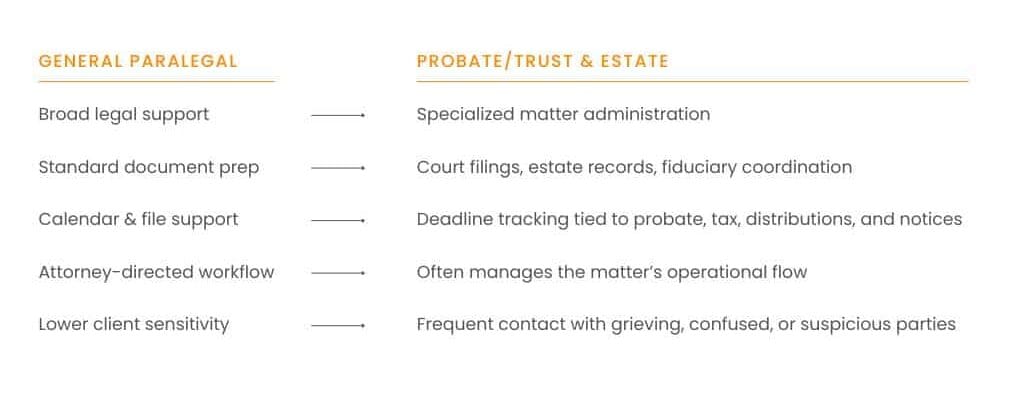
A general practice paralegal may support attorneys across several matter types. Their work can include drafting correspondence, organizing files, calendaring deadlines, communicating with clients, filing documents, and helping attorneys stay prepared.
While that experience is valuable in any paralegal role, it just doesn’t automatically prove probate, fiduciary, or estate administration capability.
A general practice paralegal may know how to keep a legal matter organized, but that doesn’t mean they’ve handled creditor notices, estate inventories, trustee communications, fiduciary accounting support, or probate filings.
When firms treat general paralegal experience as a substitute for estate-specific experience, the search can move forward with candidates who look qualified on paper but need more training than the firm has time to provide.
Trust & Estate Planning Paralegals
A trust and estate planning paralegal usually works on the front end of the client relationship. Their work may include client intake, wills, trusts, powers of attorney, advance medical directives, asset summaries, signing appointments, document production, and trust funding follow-up.
This role takes accuracy, client service, software familiarity, and a strong understanding of the firm’s planning process. The candidate needs to help move the planning workflow forward without creating errors in names, beneficiaries, assets, execution documents, or client instructions.
Planning experience is valuable, but it’s not the same as administration or probate experience. A planning paralegal may be strong at drafting and signing coordination but may not have worked through what happens after a client dies, when assets need to be collected, beneficiaries need updates, creditors may need notice, and the estate or trust has to be administered.
Trust & Estate Administration Paralegals
A trust and estate administration paralegal supports what happens after death or after a trust needs to be administered. Their work may include gathering asset information, tracking date-of-death values, communicating with trustees and beneficiaries, organizing account records, coordinating distributions, supporting accountings, and helping attorneys communicate with CPAs, banks, financial advisors, and other outside parties.
This role requires a stronger administrative and financial-documentation skillset than many firms realize. The candidate may need to understand how to organize estate assets, follow up on missing records, track who has received which documents, and help the attorney keep the matter moving without losing control of the file.
This is also where client communication becomes more sensitive. Beneficiaries may be impatient. Trustees may be unsure of their obligations. Family members may be grieving or frustrated. A strong administration paralegal can keep communication organized without overstepping into legal advice.
Trust & Estate Fiduciary Paralegals
A trust and estate fiduciary paralegal is often closest to the financial and records side of the work. These candidates may support executors, trustees, administrators, guardians, or other fiduciaries.
Their work can involve inventories, accountings, ledgers, fiduciary correspondence, asset tracking, distribution records, and documentation that has to be clean enough for the attorney, fiduciary, court, accountant, and beneficiaries to rely on.
This is one of the reasons the role can feel closer to accounting or tax-support work than firms expect. The paralegal may not be acting as a CPA, but they may be organizing the information that CPAs, attorneys, and fiduciaries need in order to do their jobs. If that information is late, incomplete, or disorganized, the attorney often has to step in and rebuild the file.
Probate Paralegals
A probate paralegal works closest to the court-facing side of estate administration. The work may include preparing petitions, filing probate documents, tracking court deadlines, coordinating executor or administrator paperwork, handling notices, organizing creditor claims, helping prepare inventories, and supporting the process needed to open, administer, and close an estate.
ACTEC describes probate as a court process that validates a deceased person’s will, oversees estate administration, settles debts, distributes assets to beneficiaries, resolves disputes, and finalizes the transfer of assets. That process creates a different kind of paralegal role because the work is tied to deadlines, court requirements, documentation, and communication with multiple parties.
A probate paralegal has to understand how the matter moves from opening to closing. They need to know what filings are still missing, which deadlines are approaching, which notices need to go out, which records still need to be gathered, and where the estate is likely to stall.
These roles overlap, but they’re not interchangeable. A planning-focused paralegal may not have probate court experience. A general practice paralegal may not understand fiduciary records. A trust administration paralegal may not have handled the filing rhythm of a probate estate. The hiring process gets harder when all of those differences are hidden under a single broad title of “paralegal”.
Why the Candidate Pool Is So Narrow
Probate and trust and estate paralegals are hard to find because the best candidates sit at the intersection of several skillsets.
They need legal skills, but legal skills alone aren’t enough. Many roles also require financial organization, tax-adjacent coordination, client communication, software fluency, and comfort working around sensitive family dynamics.
The Work Can Become Tax-Adjacent Quickly
The tax-adjacent side is one of the biggest reasons these roles become more specialized. The IRS says fiduciaries of domestic decedent estates and trusts use Form 1041 to report estate or trust income, deductions, gains, losses, income accumulated or distributed to beneficiaries, and income tax liability. The IRS also says Schedule K-1 is used to report a beneficiary’s share of estate or trust income, credits, deductions, and related items.
A paralegal may not have to prepare the tax return, but they may be gathering records, organizing documents, tracking information, and coordinating with CPAs or tax professionals so the matter keeps moving. That work can start to resemble parts of accounting or tax support in addition to normal paralegal work.
That’s why a candidate with only general legal support experience may struggle in an administration-heavy or probate-heavy role. The firm may need someone who understands legal documents and knows how to keep financial records, tax documents, asset information, and outside-advisor communication organized.
High-Net-Worth Client Work Raises the Bar
High-net-worth client work can add another layer of complexity. These matters may involve multiple accounts, business interests, real estate, investment records, family trusts, privacy concerns, outside advisors, and beneficiaries with competing expectations.
The paralegal may need to help organize information across attorneys, CPAs, wealth advisors, banks, trustees, executors, and family members. That work requires discretion and follow-through. It also requires enough judgment to know when a question can be answered administratively and when it needs attorney involvement.
For law firms, this matters because the paralegal is often one of the people keeping the matter from feeling chaotic to the client. A missed update, misplaced document, or vague communication can create unnecessary anxiety in matters that are already personal and sensitive.
Communication Is Part of the Work
Probate and trust administration often happen while families are grieving, frustrated, confused, or worried about money. Executors and trustees may not understand their responsibilities. Beneficiaries may want updates before the firm is ready to provide them. Financial institutions may need repeated follow-up. CPAs may be waiting on documents. Attorneys may need the paralegal to keep all of that organized while they handle legal strategy.
Strong candidates know how to communicate clearly, stay calm, avoid overpromising, and recognize when an attorney needs to step in.
That communication burden is one reason the role is hard to fill. The firm isn’t just hiring someone to move documents. It’s hiring someone who can support a legal process while dealing with people who may be under stress, dealing with grief, or managing family conflict.
Technology and AI Make Clean Workflow Habits More Important
Technology has raised the standard for legal support work. The ABA’s 2024 Cloud Computing TechReport reports that about 75% of attorneys use cloud computing for work-related tasks. Clio’s Legal Trends Report reports that 79% of legal professionals use AI in their firms, while more than half say their firm either has no AI policy or they’re unaware of one.
For probate and trust and estate practices, that means paralegals need clean digital habits. They need to manage secure files, client portals, document versions, e-signatures, tax records, accounting documents, and AI-assisted workflows carefully. You don’t need a legal tech guru, but you do need someone who understands that a small workflow mistake can create a bigger problem when sensitive client information, estate records, or fiduciary documents are involved.
The strongest candidates understand how estate work moves, where it gets delayed, which details create risk, and how to keep attorneys from having to rebuild the file after the fact.
Aligning the Compensation with the Complexity of the Role
General paralegal benchmarks can give firms a baseline, but they shouldn’t be the only compensation reference for probate and trust and estate roles. The work is too specialized to lump it into the same category as general paralegal work.
Our recent Virginia market data shows the differences in compensation clearly. Based on recent placements and reported salaries from interviewed candidates, General Practice Paralegals with roughly four years of experience averaged about $55,000/yr. A comparable Trust & Estate Planning Paralegal averaged about $64,000/yr and a Trust & Estate Administration/Probate Paralegal averaged about $72,000.
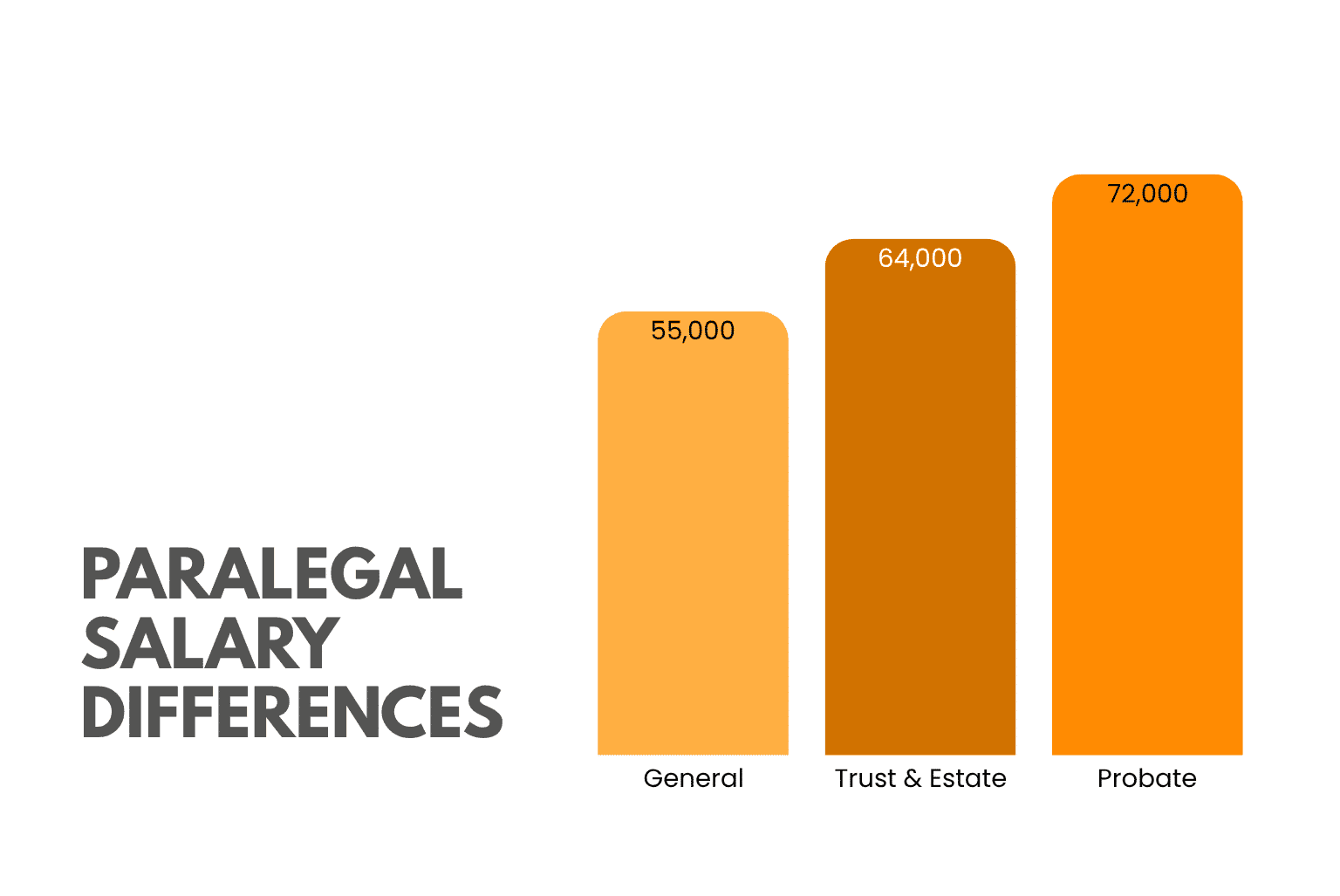 Virginia Compensation Averages from Prime Legal Market Data
| Role Type |
Average Salary |
Difference vs. General Practice Paralegal |
| General Practice Paralegal |
$55,000 |
Baseline |
| Trust & Estate Planning Paralegal |
$64,000 |
+$9,000 / +16.4% |
| Trust & Estate Administration / Probate Paralegal |
$72,000 |
+$17,000 / +30.9% |
Source: Prime Legal internal Virginia placement and candidate interview data for paralegals with roughly four years of experience.
The salary differences between the roles make sense when you look at the responsibilities and duties of each role.
Planning support can be highly valuable, especially when the firm needs strong drafting habits, client intake, signing coordination, document production, and trust funding follow-up. Administration and probate-heavy roles often add another layer of complexity: court filings, fiduciary records, beneficiary communications, accountings, asset documentation, creditor issues, CPA coordination, and estate tax or fiduciary income tax workflows.
The Trust & Estate Administration/Probate Paralegal average was $8,000/yr higher than the Trust & Estate Planning Paralegal average in this Virginia market data. That’s a 12.5% premium over the planning-focused role.
The main point here? The title shouldn’t determine the pay. The scope of the work should.
If the person is expected to manage a complex estate administration workflow, keep fiduciary records clean, coordinate with outside advisors, communicate with beneficiaries, and support probate filings, the compensation should reflect that level of responsibility. The same applies to flexibility and workload. A firm asking for a rare skillset will have a harder time competing if the pay, schedule, attorney support structure, and matter volume don’t match the work.
Why General Job Board Ads Often Miss These Candidates
A job board ad may bring in applicants. It doesn’t always bring in the right applicants.
That’s especially true for probate and trust and estate searches. A broad posting may attract general practice paralegals, legal assistants, litigation paralegals, real estate paralegals, estate planning admins, or candidates with partial exposure to estate documents. Some may be good legal professionals, but they may still lack the exact experience the firm needs.
Experienced probate and trust and estate paralegals are also often passive candidates. They may already be working in firms that value their experience. They may be selective because they know the skillset is difficult to replace. They may not be scrolling job boards unless they have a strong reason to move.
That creates a different kind of hiring problem. More applicants don’t help if most of them have adjacent experience instead of the exact experience needed. Firms need a search process that can separate planning from administration, administration from probate, and general legal support from fiduciary or tax-adjacent work.
The Biggest Mistake When Hiring Probate/T&E Paralegals
Many firms combine planning, administration, fiduciary support, and probate into one post without explaining which parts matter most. The job description may ask for “trusts and estates experience,” but that phrase can mean several different things. A candidate reading the post may not know whether the firm needs drafting support, probate administration, fiduciary accounting help, client communication, or all of the above.
Firms also tend to understate the financial and record keeping side of the role. Probate and trust administration can involve account records, asset inventories, date-of-death values, distribution information, creditor details, tax documents, and CPA coordination. If the job description only talks about drafting and client contact, the firm may attract candidates who aren’t prepared for the record management behind the matters.
Screening can create another problem. Years of experience are useful, but they don’t prove the right experience. Four years in litigation isn’t the same as four years in probate. Four years of estate planning drafting isn’t the same as four years of estate administration. A strong screen has to ask what the candidate has actually handled, not just how long they’ve worked in a legal role.
Compensation and flexibility can also work against the firm. If the firm needs someone with probate procedure, fiduciary records, tax-adjacent coordination, and high-net-worth client communication, the offer has to reflect the market for that experience. When the package looks closer to a broad general paralegal role, stronger candidates may never enter the process.
How a Legal Recruiter Helps Firms Compete for These Candidates
A legal recruiter can help by narrowing the search before the market ever sees the role.
For probate and trust and estate searches, that means clarifying the role first. Does the firm need estate planning support? Probate administration? Trust administration? Fiduciary accounting support? High-net-worth client experience? CPA coordination? Court filing experience? A hybrid candidate who can handle several of those areas?
The answer changes the candidate pool we’re targeting.
A recruiter can also reach candidates who aren’t applying to public postings. In a niche practice area, that can be a huge advantage. Experienced probate and trust and estate paralegals may be open to the right opportunity, but they’re less likely to respond to or even see a vague job ad that doesn’t reflect their skill level or market value. A legal recruiter has access to networks and resources that allow them to target candidates with the skills you need, even when the candidates aren’t actively searching for opportunities.
The evaluation of candidates is just as important as outreach. A legal recruiter can help determine whether a candidate’s experience is truly aligned with the firm’s needs. Has the candidate handled probate from opening to closing? Have they worked with fiduciary records? Do they understand trust administration? Have they coordinated with CPAs? Have they worked with high-net-worth families? Can they explain the difference between planning support and estate administration support?
At Prime Legal, we offer paralegal recruitment services to firms and companies struggling to fill complex roles like these. The value in our services doesn’t come from generic applicant volume. The value we provide is legal-market access, role-specific recruiting knowledge, candidate vetting, and a better match between the firm’s actual work and the candidate’s actual experience.
A Better Strategy for Probate and Trust & Estate Paralegal Hiring
Firms that want uniquely qualified probate and trust and estate paralegals need to define the role with more precision.
The search should start with the definition of the day-to-day work. A firm should know whether it needs planning, administration, probate, fiduciary support, tax-adjacent coordination, high-net-worth client experience, or a combination of those responsibilities. From there, compensation, flexibility, workload, and screening criteria should align with the actual skillset required.
General job boards can be part of the search, but they shouldn’t be the whole strategy. When the role requires a narrow and highly valuable skillset, the strongest candidates may not be actively applying. Firms that want to compete need a more targeted search, a clearer understanding of role scope, and a compensation structure that reflects the complexity of the work.
A specialized legal recruitment firm like Prime Legal can offer assistance to firms and companies that are struggling to find the right talent for roles like these. For more information on our services, contact our team of legal recruiters! We’re happy to have a conversation with you and your team to figure out a better hiring strategy for your Probate/Trust & Estate Paralegals.
