Blog - Adapting Under Pressure: 5 Legal Practice Areas Where Roles are Being Forced to Evolve

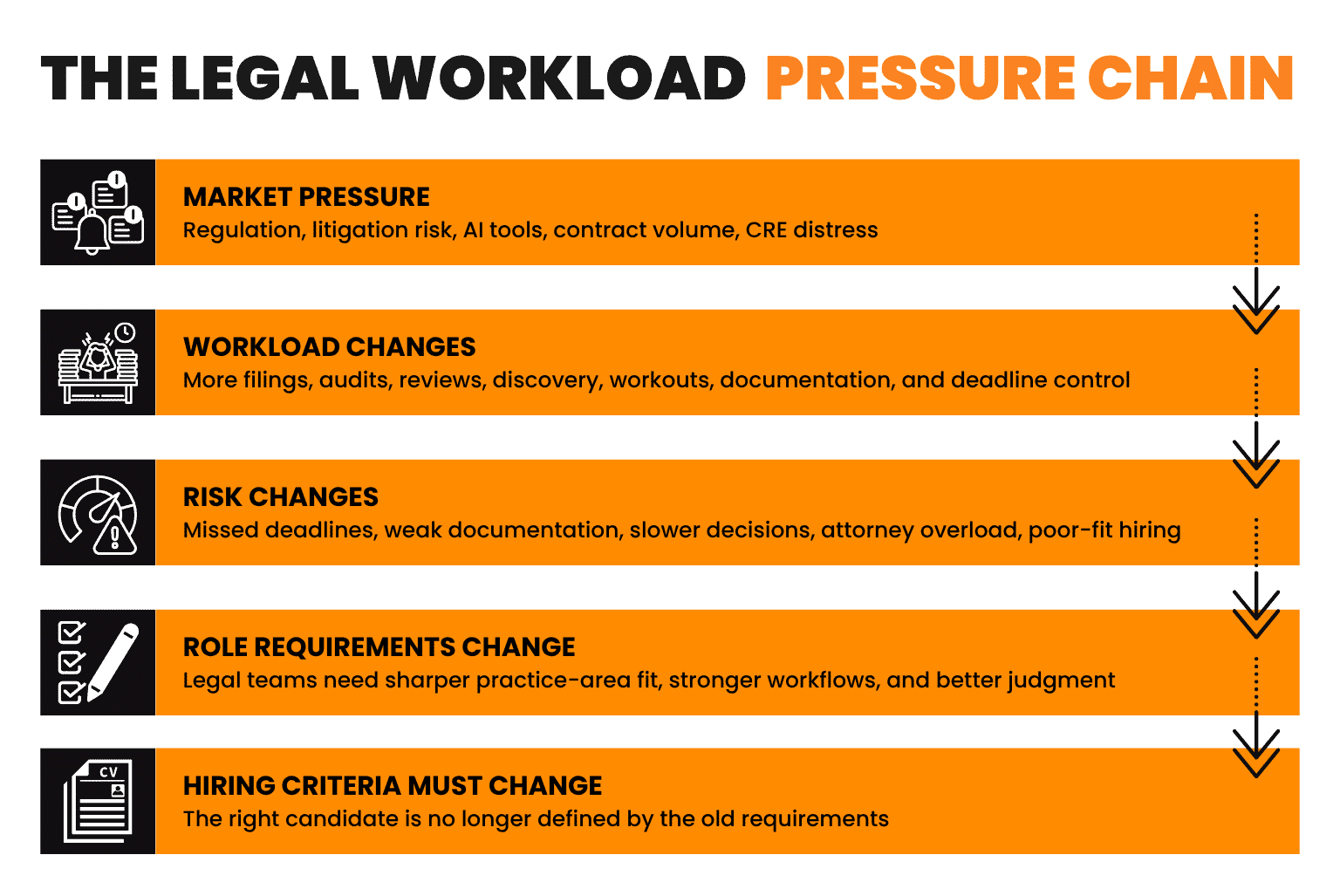
Legal teams are being hit from several directions at once right now:
- SEC reporting, proxy, crypto, and governance changes are reshaping corporate and securities work.
- Class actions, cybersecurity disputes, employment claims, and fragmented enforcement are making litigation more complex.
- Privacy and AI rules are creating new expectations around audits, risk assessments, vendor review, and automated decision-making.
- AI contract tools are changing how legal teams manage review, playbooks, approvals, and obligations.
- Commercial real estate distress is increasing work around loan maturities, workouts, foreclosures, and lender-borrower disputes.
These pressures are forcing law firms and legal departments to adapt. The changes that are occurring in the market require firms to look for different skill sets, stronger workflows, and a clearer understanding of which roles are built to handle the legal pressures they’re facing. A candidate who looked qualified under older expectations may be missing the experience/skills needed to evolve with the market.
Corporate and securities, litigation, data privacy, contract administration, and commercial real estate are already feeling the shift. Firms and companies that understand what’s changing can hire around the work ahead. The ones that ignore the signs of change may find themselves wondering why they can’t keep up with the demands of a changed market.
The Industry Pressures Reshaping Legal Hiring in 2026
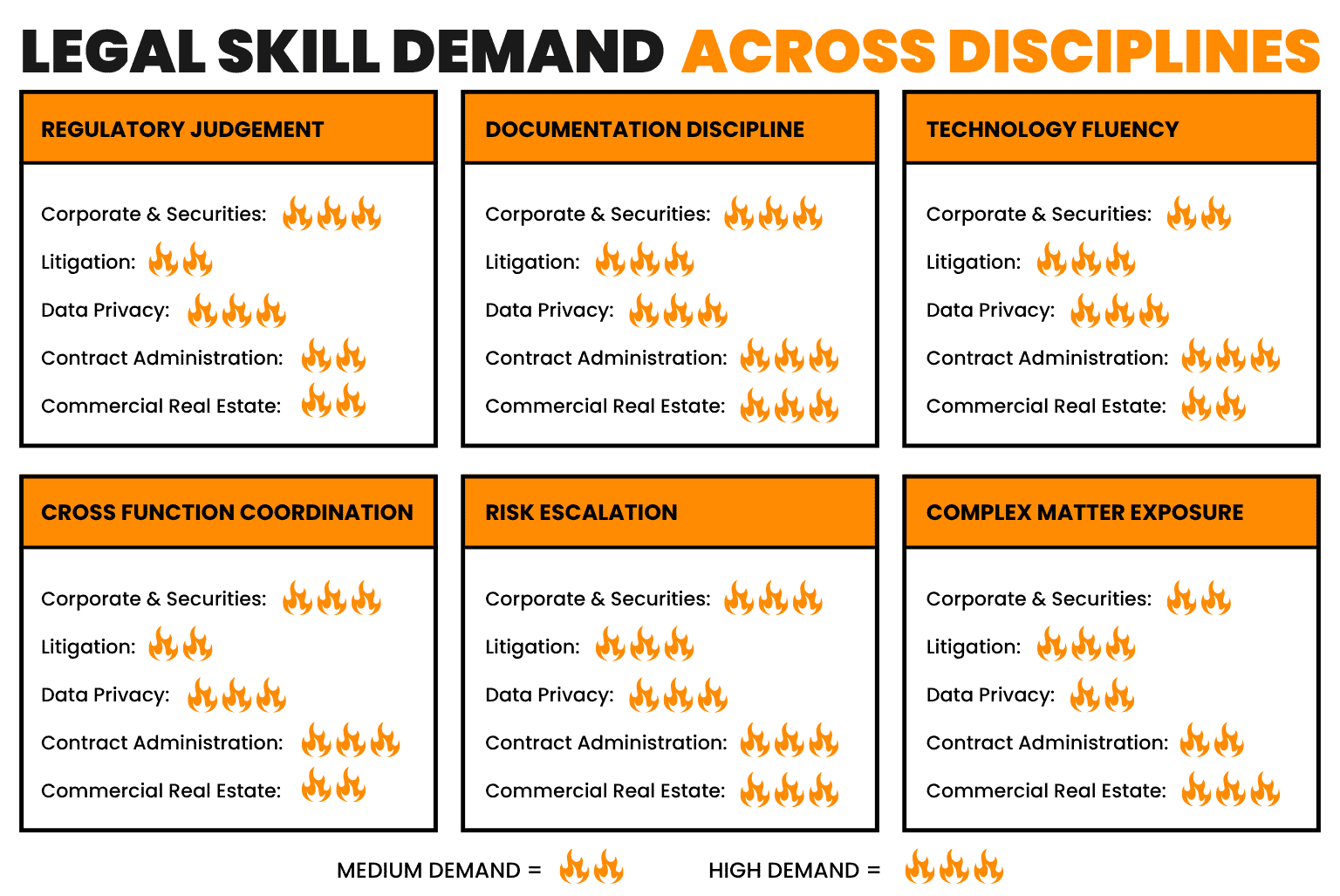
Legal hiring expectations are being shaped by regulatory change, litigation risk, technology adoption, and market stress. These trends in the legal market are reshaping hiring expectations across the 5 practice areas shown below.
| Practice Area | Industry Pressure | Workload Changes | Old Hiring Criteria | New Hiring Criteria |
| Corporate & securities | SEC reporting, proxy, crypto, and Delaware governance developments | Disclosure, board support, investor communication, transaction process risk | Broad corporate or filing experience | Governance judgment, disclosure strategy, securities fluency, board support |
| Litigation | Class-action growth, cybersecurity exposure, employment disputes, fragmented enforcement | Discovery, eDiscovery, pleadings, procedural control, risk management | General discovery and trial preparation | Complex matter control, class-action exposure, cybersecurity/privacy litigation support |
| Data privacy, cybersecurity, and AI governance | CCPA updates, cybersecurity audits, ADMT rules, AI Act uncertainty | Risk assessments, audit readiness, vendor review, incident response, AI governance | Privacy policy review and notice updates | Operational privacy capability, documentation, audit readiness, cross-functional coordination |
| Contract administration | AI-assisted review, CLM adoption, contract data pressure | First-pass review, clause control, renewals, obligations, escalation rules | Fast redlining and document processing | Playbook discipline, CLM fluency, contract data management, escalation judgment |
| Commercial real estate | Delinquencies, loan maturities, distressed debt, foreclosures, workouts | Workout support, note sales, lease issues, lender-borrower disputes, distressed transactions | Leasing, title, closing, and standard deal support | Distressed asset experience, real estate finance, workout support, litigation awareness |
Corporate & Securities: From Broad Transaction Support to Governance and Disclosure Judgment
Corporate and securities teams are dealing with a different mix of disclosure, governance, and regulatory judgment. The SEC proposed amendments that would allow public companies to file semiannual reports instead of quarterly reports if adopted. The SEC and CFTC also issued an interpretation on crypto assets, including guidance on token taxonomy, airdrops, protocol mining, protocol staking, and wrapped crypto assets.
PwC’s 2026 proxy season preview notes that voting outcomes are being shaped by changing proxy-advisor influence, fragmented investor stewardship models, retail shareholder engagement, and shifts in SEC staff responses to no-action requests.
Delaware governance remains active after the Delaware Supreme Court upheld SB21 safe-harbor provisions for certain controlling-stockholder transactions, as summarized by the Harvard Law School Forum on Corporate Governance.
Corporate hiring used to be easier to evaluate through M&A support, securities filing experience, entity management, closing support, board book preparation, and general governance exposure. While experience in these areas is still relevant, it doesn’t determine whether a candidate can connect legal process to business judgment.
For attorneys in this practice area, a better mix of experience may include:
- Public-company disclosure experience
- Board and committee support
- Securities-law judgment
- Governance process experience
- M&A and fiduciary-duty awareness
- Regulatory interpretation
- Executive communication
For corporate paralegals, qualified talent may need experience with SEC filing calendars, board materials, entity records, closing checklists, due diligence coordination, and deadline-sensitive documentation.
Litigation: From Case Support to Complex Matter Control
Lex Machina’s 2026 Class Action Litigation Report found that federal class action filings reached more than 12,200 cases in 2025, the highest volume in a decade, with consumer protection claims driving much of the increase. Norton Rose Fulbright’s 2026 Annual Litigation Trends Survey points to sustained pressure from cybersecurity exposure, employment disputes, fragmented enforcement, rising verdict amounts, evolving enforcement priorities, and resource constraints.
Litigation hiring used to lean heavily on discovery experience, calendaring, motion practice, filing knowledge, deposition preparation, trial preparation, and general case management. Those skills are still necessary, but the current market pressures are forcing litigation specialists to adapt to new demands.
What matters more now is coordination across volume, deadlines, data, vendors, experts, and procedural risk. A litigation paralegal who can organize discovery in a straightforward dispute may need different experience to support a consumer class action, privacy dispute, cybersecurity incident, or employment matter with fragmented state and federal exposure.
The stronger litigation profile may include:
- Class-action procedure exposure
- eDiscovery experience
- Document review coordination
- Cybersecurity or privacy litigation familiarity
- Consumer protection exposure
- Deadline discipline
- Ability to work across attorneys, clients, vendors, experts, and court requirements
For legal assistants, administrative precision becomes more valuable when the matter load increases because filing errors, calendar breakdowns, and missed communications can create real case risk.
Data Privacy, Cybersecurity, and AI Governance: From Compliance Review to Operational Privacy Capability
The California Privacy Protection Agency’s CCPA updates include regulations addressing cybersecurity audits, risk assessments, automated decision-making technology, and insurance regulations. The rules were approved in September 2025, with an effective date of January 1, 2026. In Europe, IAPP reported that lawmakers reached a provisional agreement to reform parts of the AI Act, including updated timelines for certain high-risk AI systems.
Privacy hiring used to center on privacy policy review, notice updates, data-processing terms, compliance checklists, outside counsel coordination, and general regulatory awareness.
The major change here is that privacy now requires proof of process.
Companies need to show how risk assessments are performed, how automated decision-making tools are reviewed, how cybersecurity audits are prepared, how vendors are evaluated, and how privacy decisions are documented. That requires legal talent that can work across IT, security, HR, procurement, product, compliance, and business leadership.
Law firms and legal departments should now be looking for skills including:
- Privacy risk assessment
- Cybersecurity audit preparation
- Vendor and data-processing agreement review
- Automated decision-making technology exposure
- AI governance
- Incident response
- Cross-functional workflow design
This is where in-house legal needs can become clearer. If privacy, cybersecurity, vendor data risk, and AI governance are recurring business issues, relying only on outside counsel can make decisions slower and less connected to daily operations.
A dedicated in-house counsel search may make sense when the company needs legal judgment close to the teams making product, employment, procurement, security, and customer-data decisions.
Contract Administration: From Document Processing to Playbook-Driven Contract Control
Microsoft’s Legal Agent for Word is designed to help legal teams review contracts, identify risks, compare clauses to internal playbooks, and generate tracked-change edits inside Word, according to a Microsoft 365 Copilot update. Docusign also introduced an AI-powered agreement assistant that can help create review playbooks, analyze agreements, flag risky language, suggest edits, and draft new language.
Contract hiring used to focus on speed, organization, redlining ability, template familiarity, routine agreement processing, and routing documents through approval workflows. When legal teams are trying to standardize contract review and manage risk across a large contract base, this old skillset might not cut it.
The newer expectation is playbook discipline.
Legal teams need contract administrators, contracts paralegals, commercial counsel, and legal operations professionals who understand:
- Fallback language
- Escalation thresholds
- Clause libraries
- CLM systems
- Metadata
- Renewal tracking
- Post-signature obligations
A candidate who can redline quickly may miss the larger risk if they don’t know when a clause needs attorney review, business approval, or a deviation from standard terms.
For hiring teams, the practical question is whether the backlog is caused by attorney-level negotiation needs or by process gaps that better contract support could absorb. In many cases, a contracts paralegal, contract administrator, or commercial legal support role can reduce pressure on attorneys by improving intake, first-pass review, document control, and obligation tracking.
Commercial Real Estate: From Traditional Deal Support to Distressed Asset and Workout Experience
Commercial real estate legal work is being shaped by distress, refinancing pressure, and the slow process of resolving troubled assets. It changes the legal work that firms and companies need to staff.
Trepp reported that the CMBS office delinquency rate reached 12.34% in January 2026, a new all-time high, driven by higher interest rates, structural demand shifts, and looming maturities. In addition, MBA reported that delinquency rates for mortgages backed by commercial properties increased to 4.02% in the first quarter of 2026, up from 3.86% in the previous quarter. MBA also reported that 17% of outstanding commercial and multifamily mortgage balances (worth $875B), are scheduled to mature in 2026.
Commercial real estate hiring used to emphasize leasing, purchase and sale transactions, title review, closing support, due diligence, real estate finance documents, and lease abstraction. But now firm and legal departments are dealing with distressed CRE work that often crosses real estate, finance, litigation, restructuring, lease analysis, title, and documentation at the same time.
A lawyer who has only handled standard acquisitions may not have the same experience needed for a loan workout, note sale, foreclosure, receivership, lender-borrower dispute, or distressed asset transaction.
A CRE paralegal who is strong with closing binders and title review may also need experience with lease abstraction, UCCs, loan documents, portfolio review, and diligence across distressed assets.
Today’s top commercial real estate candidates may need a stronger skillset involving:
- Loan workout experience
- Foreclosure familiarity
- Distressed transaction support
- Lender-borrower dispute exposure
- Note sale support
- Lease review
- UCC and title discipline
- Restructuring-adjacent awareness
How to Identify What Kind of Legal Help You Actually Need
Don’t immediately assume you know which role you need to hire for or that the required skills of that role will be the same as they were 5 years ago.
First, identify what’s changed.
Are you seeing more board and disclosure work? More discovery and filings? More privacy and vendor reviews? More contract review backlogs? More CRE workouts, foreclosures, or distressed transactions? The answer tells you which practice area is creating pressure.
Second, identify the risk attached to that work.
A filing backlog creates deadline risk. A privacy assessment creates documentation and regulatory risk. A contract renewal problem creates business and revenue risk. A foreclosure dispute creates litigation, finance, and documentation risk.
Third, separate legal judgment from legal support.
Attorney judgment may be needed for governance advice, privacy interpretation, litigation strategy, contract negotiation, or CRE workout strategy. Paralegal, legal assistant, contract administration, or legal operations support may be better suited for due diligence, filings, discovery coordination, closing binders, contract tracking, lease abstraction, and deadline management.
Fourth, match the role to the needs being created by market pressure.
| If the pressure is… | You may need… | Why |
| Board, disclosure, governance, or transaction complexity | Corporate attorney, securities counsel, corporate paralegal | The work requires regulatory judgment, filing discipline, and transaction support. |
| Discovery volume, class actions, filings, or trial prep | Litigation paralegal, litigation associate, legal assistant | The risk is deadline control, document flow, and matter capacity. |
| Privacy, AI, cybersecurity, or vendor data risk | Privacy counsel, in-house counsel, compliance legal support | The work requires cross-functional legal judgment and documentation. |
| Contract backlog, renewal issues, or weak obligation tracking | Contracts paralegal, contract administrator, commercial counsel | The work requires playbooks, escalation rules, and post-signature control. |
| CRE workouts, foreclosures, or distressed transactions | Real estate attorney, finance counsel, CRE paralegal | The work crosses real estate, finance, litigation, and due diligence. |
Finally, decide whether the pressure is recurring, project-based, or tied to a specific matter. Recurring work may justify a permanent role. Matter-specific pressure may require extra support for a defined period. Strategic, business-facing risk may require more senior legal judgment. Documentation-heavy work may require stronger legal support rather than another attorney.
Where Specialized Legal Recruiting Fits
Once you understand where your workload pressure is coming from and who you need for the job, a specialized legal recruiter can help you find candidates with the right legal background, practice-area experience, discretion, and expectations.
Prime Legal frequently works with legal firms and in-house teams looking for paralegals, attorneys, legal support staff and executives who work in litigation, corporate & securities, data privacy, contract administration, commercial real estate and more. We offer both direct and temporary hires along with confidential searches. To learn more or start your search, reach out to our team!
