Blog - The Trait That Separates Strong Family Law Hires from Risky Ones

Divorce, custody disputes, support fights, coercive control, domestic violence issues, parenting conflict, and repeated emotional escalation. These are the issues that lawyers and paralegals deal with daily in family law.
The emotional conditions around that work shape how the job is actually performed. Because of this, many family law firms put unusual weight on emotional stability when they evaluate lateral attorneys and paralegals. In this practice area, a polished resume can open the door, but it doesn’t prove that someone can function well when clients are overwhelmed, opposing parties are volatile, and the facts of the case keep touching fear, anger, grief, and control.
Why Emotional Stability Carries So Much Weight in Family Law
In many practice areas, pressure comes from deadlines, complexity, or financial stakes. In family law, those pressures are still present, but they sit inside intense personal disputes. These clients aren’t just upset about a contract term or a business loss; a client may be afraid of losing parenting time, managing abuse allegations, protecting children, facing relocation issues, or trying to separate from a spouse who has already made daily life unstable. That emotionally charged environment changes the demands put on the people handling the matter.
AFCC’s family-court practice resources reflect that reality through dedicated guidance on parenting plan evaluations, parenting coordination, intimate partner violence, mediation, and other conflict-heavy family-law processes. The ABA Family Law Section’s domestic-violence coverage also makes clear that family lawyers should expect to encounter these issues in real practice, not as rare exceptions.
When hiring these roles, assessing emotional stability becomes necessary. In family law, emotional instability can show up in rushed advice, reactive emails, poor boundaries with clients, avoidable conflict with opposing counsel, uneven case management, and bad judgment about when to push and when to slow a matter down.
A firm hiring in this environment is often asking a practical question: can this person stay steady enough to be useful when the emotional pressure rises?
What Emotional Stability Actually Looks Like in a Family Law Hire
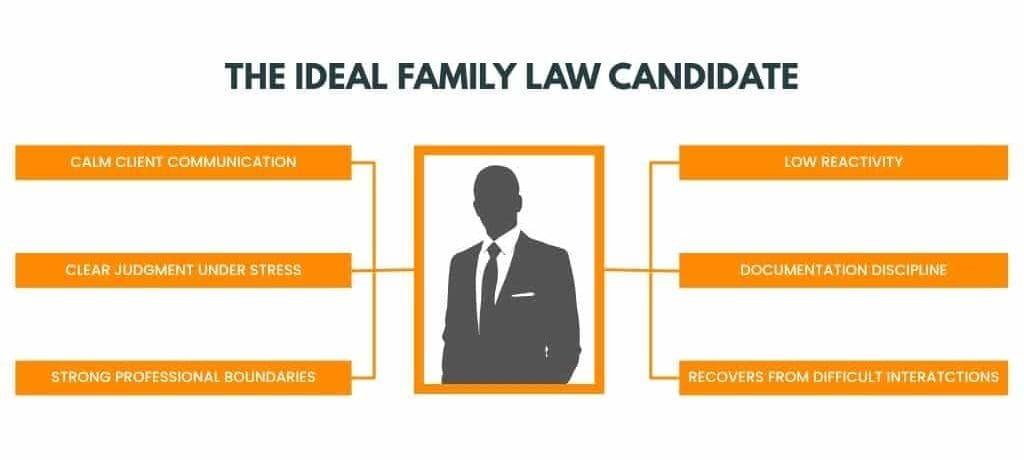
Firms are not looking for robotic detachment and they’re not looking for someone who appears cold under pressure. In family law, emotional stability usually means a professional can hear and observe distress without absorbing it, respond to urgency without becoming frantic, and keep the quality of the work intact even when the client’s life is in chaos.
A stable hire can tell the difference between a real emergency and an emotionally urgent demand. A stable hire can listen to a furious client without matching the tone. A stable hire can sit through hostile communications, complicated custody facts, or domestic-violence-related allegations and still think clearly enough to protect the client’s position. Just as important, a stable hire can recover from one difficult interaction and move into the next case or next task without carrying emotional spillover into everything else.
In family law, the ability to keep calm in the midst of intense emotions is required.
Why a Strong Resume Alone Does Not Solve the Problem
The Florida Bar describes board certification in marital and family law as identifying lawyers with special knowledge, skills, and proficiency, along with the character, ethics, and reputation for professionalism needed to be recognized publicly as specialists. North Carolina’s family-law specialization standards also go beyond surface credentials, requiring substantial involvement in family law, peer review, continuing legal education, and an exam process.
Family law doesn’t just test whether someone knows the law. It tests whether they can keep using good judgment while the people around them are behaving at their worst.
Why Emotional Stability Matters in Attorney Hires
For attorneys, emotional stability affects judgment first. Family law attorneys are constantly making decisions in environments where clients want immediate relief, facts arrive in emotionally loaded form, and the wrong tone can make a conflict more expensive. An attorney who can’t stay centered under pressure is more likely to overreact, overpromise, or turn manageable conflict into full escalation.
This also affects client management. Family law clients need candor, structure, and clear expectations. They often do not need a lawyer who will intensify every grievance to prove loyalty. They need someone who can say, calmly and credibly, what matters now, what does not, what the court is likely to care about, and what the next step should be. Emotional stability supports that kind of trust. It allows a lawyer to be firm without being inflammatory and empathetic without becoming captured by the client’s emotional state.
It also affects negotiation and courtroom presence. In family law, not every strong lawyer is the loudest one in the room. The better lawyer is often the one who can absorb pressure, read the situation accurately, and stay strategic when the other side is trying to provoke a reaction. That is one reason professionalism and reputation matter so much in family-law specialization standards. A volatile lawyer can damage the client’s matter and the firm’s standing at the same time.
Why Emotional Stability Matters in Family Law Paralegal Hires
The same issue appears differently with paralegals. In family law, paralegals are often close to the emotional traffic of the case. They may be the person receiving distressed updates, following up on sensitive records, managing calendars tied to parenting schedules or hearings, organizing financial documents, and helping keep the matter moving when the attorney is handling the strategic layer.
That means emotional stability in a paralegal often shows up as calm communication, documentation discipline, and composure under repeated client pressure. A paralegal who gets overwhelmed by client emotion can lose accuracy, blur boundaries, or let one heated interaction disrupt the rest of the day’s work. In a family-law matter, those are not small failures. They can affect deadlines, records, confidentiality, and the client’s overall confidence in the firm.
The Difference Between Compassion and Reactivity
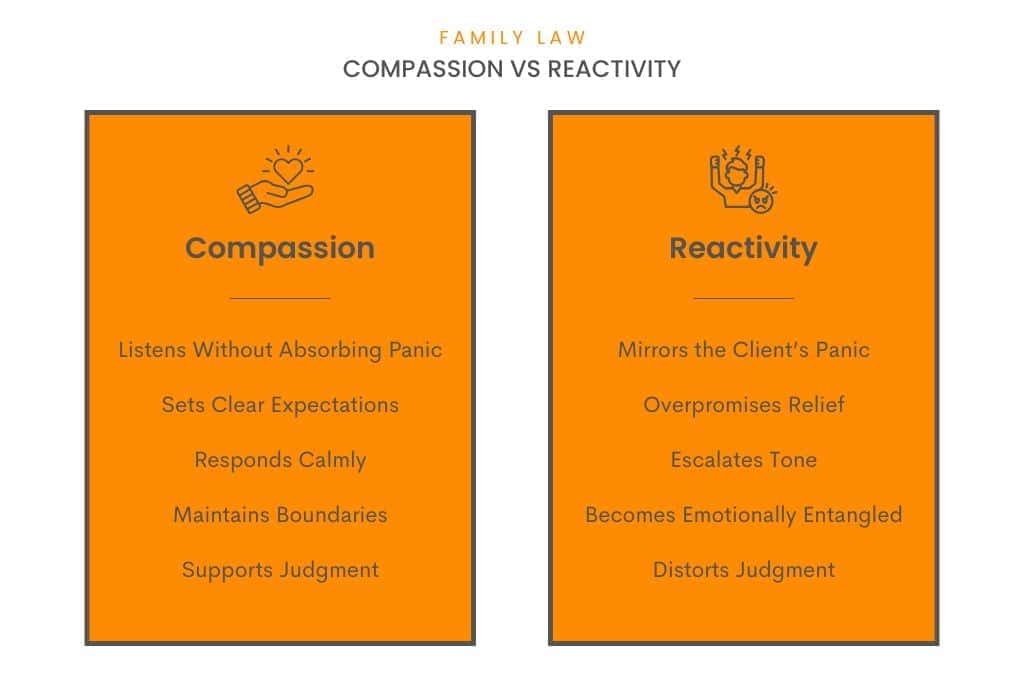
Family law firms need compassionate people. A client going through divorce, custody litigation, or abuse-related conflict should not feel managed by someone emotionally flat or indifferent. But compassion is not the same as reactivity.
Compassion helps a professional listen well, explain clearly, and respond with respect. Reactivity does something different. It mirrors panic, adopts the client’s anger, rushes to endorse every emotional conclusion, and makes boundaries harder to maintain. In practice, compassion improves professional judgment. Reactivity distorts it.
That distinction matters because many family law firms are not looking for emotionally distant hires. They are looking for people who can stay humane without becoming entangled. In a high-conflict practice, that balance is often what separates someone who can last in the role from someone who burns out, escalates matters, or creates instability for the rest of the team.
How Family Law Firms Try to Evaluate Emotional Stability
No firm can measure emotional stability perfectly in an interview. What firms can do is look for signals.
One signal is consistent family-law exposure. Candidates who have spent real time handling divorce, custody, support, enforcement, protective-order, and modification matters are more likely to understand the pace and emotional structure of the work.
Another signal is how they talk about difficult clients, former colleagues, or opposing parties. A candidate who sounds contemptuous, theatrically aggressive, or eager to describe everyone as unreasonable may raise concerns, even if the resume is strong.
References and peer reputation matter too. In a specialty where professionalism is explicitly valued and specialization standards include peer review, firms have reason to care about how someone is known in the family-law community. They may also use hypotheticals to hear how a candidate handles an emotionally intense client, a fast-moving custody issue, or a situation involving abuse allegations or severe conflict. The goal is not to find someone with rehearsed answers; it’s to find someone whose thinking stays grounded when the facts do not.
What This Means for Family Law Hiring Strategy
If emotional stability is truly important, family law firms must treat it as a real hiring criterion instead of assuming it will appear automatically alongside credentials. That starts with honesty about the work. A job description that talks only about experience and case types misses the real environment. Family law hiring should describe the practice for what it is: high client contact, emotional intensity, conflict management, sensitive facts, and the need for clear judgment under stress.
It also means separating aggression from usefulness. In family law, the most visibly forceful candidate is not always the most effective one. Firms are often better served by hiring people who can regulate themselves, keep a matter organized, communicate calmly, and make strategic decisions without feeding unnecessary conflict.
That applies to both lateral attorneys and paralegals. The tasks differ, but the operational question is the same. When the facts get messy, the client gets upset, and the conflict stops being neat, will this person make the practice steadier or harder to hold together?
The Strongest Family Law Hires Usually Bring More Than Experience
Experience matters. Subject-matter knowledge matters. Courtroom ability matters. Family-law terminology, procedure, and judgment all matter. But in a high-conflict family-law practice, those strengths do not stand on their own for very long. They depend on emotional stability.
A family law firm is not just hiring for capability in calm conditions; it’s hiring for capability inside distress, accusation, fear, urgency, and repeated human volatility. The stronger hire is usually the one who can stay composed enough to make all of their other qualifications usable when the case becomes difficult. In family law, that is often the difference between someone who appears impressive and someone who is actually built for the work.
If you’re looking for better family law candidates, let the legal recruiting experts at Prime Legal help you with your search. Reach out today!
