Blog - From Law School to Partner: What Legal Recruiters Expect at Each Stage

Legal hiring looks steady from the outside. It isn’t.
The Bureau of Labor Statistics projects about 31,500 openings for lawyers each year, and most of those come from replacement, not growth.
Think about what that means. Firms aren’t expanding their staff like a Series B startup. They’re backfilling someone who retired, lateraled out, or decided BigLaw wasn’t worth the grind.
When a recruiter reviews your résumé, they’re not admiring your credentials. They’re asking one blunt question: If we hire this person, will they actually reduce the burden on the people already drowning in work?
That calculation changes at every level. And it gets harsher as you climb.
Entry-Level Lawyers: Are You Worth the Training Time?
Hiring a junior lawyer is expensive speculation. The firm pays your salary, benefits, bar fees, and sinks hundreds of hours into training you. They’re betting you’ll become billable and reliable before they lose patience.
BLS data shows a huge chunk of lawyers are over 50. Retirements are coming, yet firms still hesitate to hire juniors who seem unfocused.
Recruiters screen for three things that candidates dismiss as “soft factors.” They’re not soft. They determine whether you get the offer.
Evidence Of Direction That Goes Beyond Interest
Saying you’re “interested in litigation” means nothing. Recruiters want a pattern.
Maybe it’s a litigation clinic, trial advocacy, a judicial internship, and a writing sample that sounds like you actually enjoy arguing. Clerkships still carry weight for litigation and appellate work because they validate your writing and judgment.
You don’t need a federal clerkship. You just need to look like you’ve been aiming at something specific for longer than six months.
Geographic Commitment That Looks Real
Firms won’t say this in interviews, but geographic uncertainty terrifies them.
If you have no ties to a city, you’re interviewing in three markets, and you’re vague about bar plans, they’re already picturing you leaving in 18 months. Replacing a junior associate costs more than the original hire, and in a replacement-driven market, firms crave continuity.
Make it obvious: Take the bar where you plan to stay. Explain your geographic choice in one clean sentence. Family ties, partner’s job, prior time there. Whatever it is, keep it consistent across your résumé and interviews. Recruiters notice when your story shifts.
Writing That Doesn’t Require Partner Editing
Your writing sample gets circulated more than you think. If a senior lawyer has to rewrite every paragraph, you’ve just signaled a massive supervision cost.
A strong sample doesn’t need brilliant arguments. It needs clean structure, accurate citations, and a tone that sounds like a lawyer instead of a law review editor chasing footnotes.
The preparation here isn’t mysterious. It’s straightforward: align your coursework with your target practice, collect real work product, polish your writing, and pick a market.
Junior & Midlevel Associates: Can You Run a Matter Without a Babysitter?
By year three, the training wheels come off. Firms expect you to generate leverage, which means you take work off a partner’s desk and return something usable.
NALP’s research shows that lateral mobility is normal for associates. Random job-hopping without skill progression isn’t.
Recruiters at this stage are listening for competence that immediately reduces partner time.
Defined Skill That a Partner Can Sell
Sure, a recruiter can place a “midlevel litigation associate” easily. But hiring partners want specifics:
Commercial litigation with real discovery management. Product liability with deposition experience. Employment litigation with dispositive motion drafting. M&A with purchase agreement work and diligence leadership. Regulatory matters with agency-facing experience.
Georgetown’s Center on Ethics and the Legal Profession has tracked increasing pressure around efficiency in legal services. Those pressures show up in how firms staff cases.
Recruiters respond by hunting for associates who can contribute faster.
Ownership That Can Be Explained Without Inflating
Too many résumés use the same lazy verbs: “assisted,” “supported,” “worked on.” Recruiters translate those as: unclear role, probably minimal.
Real ownership has a simple test. You controlled a piece of work with minimal direction, and the output went to a client, court, opposing counsel, or deal team.
“Drafted the first version of the motion to compel and argued it at the hearing” gives a recruiter ammunition. “Supported discovery” forces them to ask follow-ups they’d rather skip.
Document this properly: Keep a private matters log. Date, case name, your role, what you delivered. Note whether you drafted first or just edited sections. Track what went external.
You’ll thank yourself later. When a recruiter asks for representative matters, you won’t be scrambling to reconstruct four years of work from memory.
Career Movement That Shows Escalation
Two moves in four years can work if the second role clearly increased complexity or responsibility. Three moves with the same vague duties? That looks like restlessness or performance problems.
Recruiters are trained to spot patterns. Unplanned movement makes them predict you’ll do the same thing after they place you.
Senior Associates: Are You Quietly Becoming Partner Material?
Senior associates often underestimate how hard the market judges them. You cost more, and the partnership clock starts ticking whether you acknowledge it or not.
With so many lawyers nearing retirement, firms care about succession even when they don’t admit it.
Recruiters look for signs you can bridge the gap between partners and clients.
Leadership That Looks Like People Trust You
Leadership isn’t a title. Recruiters want proof that other lawyers already rely on you.
Maybe you assign work to juniors and review it. You train new associates on recurring workflows. You run weekly status meetings. A paralegal just calls you directly when something breaks.
If you can’t describe how you manage people or processes, recruiters assume you still need close supervision. That’s a dealbreaker at this level.
Client Visibility That Goes Beyond Being on Emails
Client exposure gets treated like a bonus. It’s actually a promotion signal.
Thomas Reuters’ 2024 State of the Corporate Law Department report shows legal departments are taking on broader responsibilities and operating with tighter constraints, which raises the bar for outside counsel communication and day-to-day execution.
Recruiters probe for real visibility:
“Who’s the client contact on your matters?” “Have you delivered bad news directly?” “Do you run calls, or just attend them?”
If you’ve led client calls, presented options, and handled follow-ups, you look safer. Recruiters can predict smoother integration.
Early Business Development Signals That Are Credible
You’ve heard “start networking” a thousand times. It feels useless because nobody explains what counts.
Recruiters respond to concrete activity: Speaking at an industry association where potential clients show up. Writing short, practical updates tied to your niche. Building relationships with adjacent professionals like accountants or consultants. Getting pulled onto matters through internal referrals.
You don’t need to be a rainmaker. You need to show the early signs of a pipeline. Firms want to believe you’ll eventually contribute to demand, not just supply.
Partners: Can The Revenue Follow You and Will It Hold Up?
At partnership level, the conversation becomes financial.
The 2025 Report on the State of the US Legal Market notes that clients increasingly expect to control staffing and pricing decisions, while lateral partner movement remains intense, which pushes firms to scrutinize partner hires for immediate, defensible economic impact.
Recruiters treat portability like underwriting. They want to know if your revenue survives the move.
What “Portable Book” Means In Practice
Partners love to say, “My book is portable.” Recruiters don’t take that at face value.
They ask: Where does the work come from? Personal relationship, institutional panel, referral network, or firm brand? Who signs engagement letters? How concentrated is the revenue? How stable are collections?
A partner with ten clients at $200k each is safer than a partner with one $2M client tied to a panel appointment that might not transfer.
How Recruiters Validate Portability
Recruiters triangulate revenue history across multiple years. Client concentration and industry mix. Conflict analysis to see if the target firm can even take the work. Relationship mapping to figure out who at the client actually owns the decision. Subtle reference checks through mutual contacts.
If you can’t explain these factors concisely, you look risky even with strong numbers.
Fit That Includes Compensation Reality
“Fit” sounds vague. Often it means: Will your expectations collide with how the firm allocates credit?
A partner used to a high origination split may struggle at a firm where relationship partners get most of the credit. Recruiters probe this early because misalignment causes expensive failures.
In-House Lawyers: Can You Solve Business Problems, Not Just Legal Ones?
In-house roles require different credibility. You need to advise in a way that respects business constraints and internal politics.
The ACC Chief Legal Officers Survey highlights how corporate legal departments are prioritizing cost control, risk management, and operational efficiency, offering a clear view into how modern in-house teams evaluate outside counsel.
Financial and Vendor Awareness
In-house lawyers often manage outside counsel budgets without owning the relationship. Recruiters listen for evidence that you understand spend, rate negotiation, and staffing discipline.
If you can say, “I restructured outside counsel staffing to cut spend without missing deadlines,” you sound like someone who can operate.
Regulatory Literacy That Includes Enforcement Reality
Saying you’re “experienced in employment law” is too broad. Recruiters want proof you understand what’s driving risk right now.
The EEOC publishes enforcement and litigation statistics on discrimination charges, filings, and outcomes. That data shows what kinds of issues are being raised and how they’re being resolved year to year.
A candidate sounds more credible when they can translate those patterns into action, like updating retaliation training, tightening documentation practices, or revising escalation paths for complaints.
Influence Across Departments
In-house success runs on persuasion. Recruiters look for cross-functional work: HR partnerships, finance alignment, operations support, product counsel collaboration.
Candidates who describe how they got buy-in tend to outperform those who only describe what they drafted.
How Screening Has Tightened Since 2020
Two shifts are reshaping how legal recruiters operate.
First, verification is stricter. Firms are more cost-sensitive, and the market tolerates underperformance less. Thomson Reuters’ State of the Legal Market reporting reflects persistent economic pressures that flow into staffing decisions.
Recruiters are checking more: Writing samples circulate earlier. References get called sooner. Portable book claims get dissected, not admired.
Second, narrative coherence has become decisive.
Recruiters map careers like timelines. They look for cause and effect. A lateral move that increased responsibility makes sense. A sudden pivot without transitional experience triggers questions.
A litigation associate can move into regulatory work, but recruiters want to see the bridge. They want to see cases involving agencies, compliance counseling, industry exposure, or a clear reason the pivot started before the move.
Candidates who track their work product, build a coherent practice story, and make deliberate moves have easier searches.
Closing Perspective
The main takeaway? Legal recruiters are predicting outcomes.
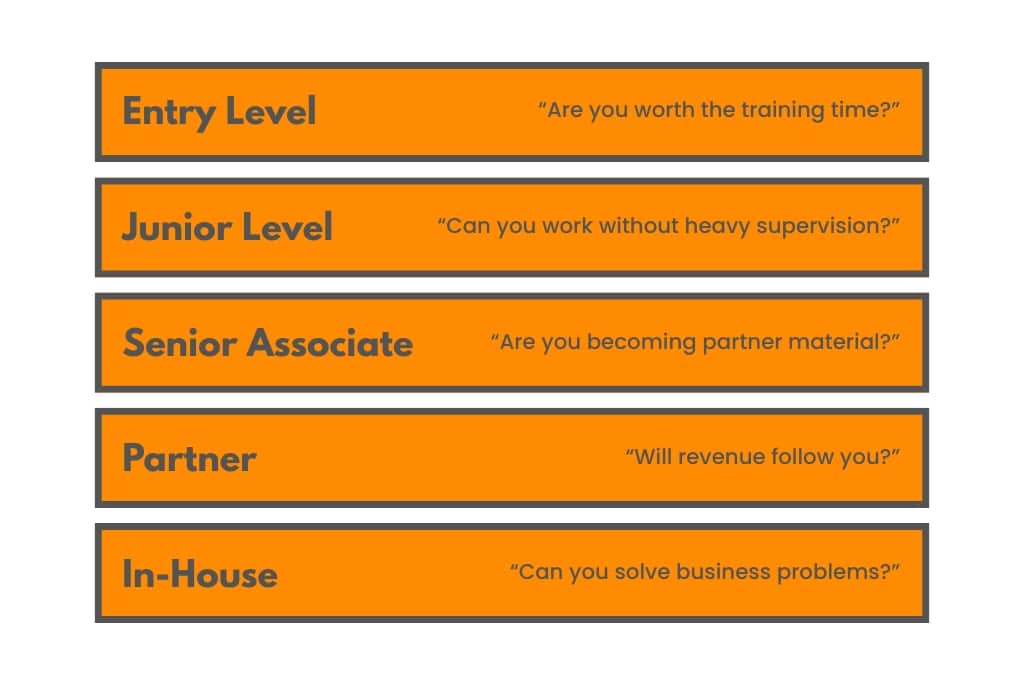
Entry-level hiring tests whether you justify training time. Midlevel hiring tests whether you reduce supervision. Senior hiring tests whether you can lead and hold trust. Partner hiring tests whether revenue survives. In-house hiring tests whether you can operate inside a business.
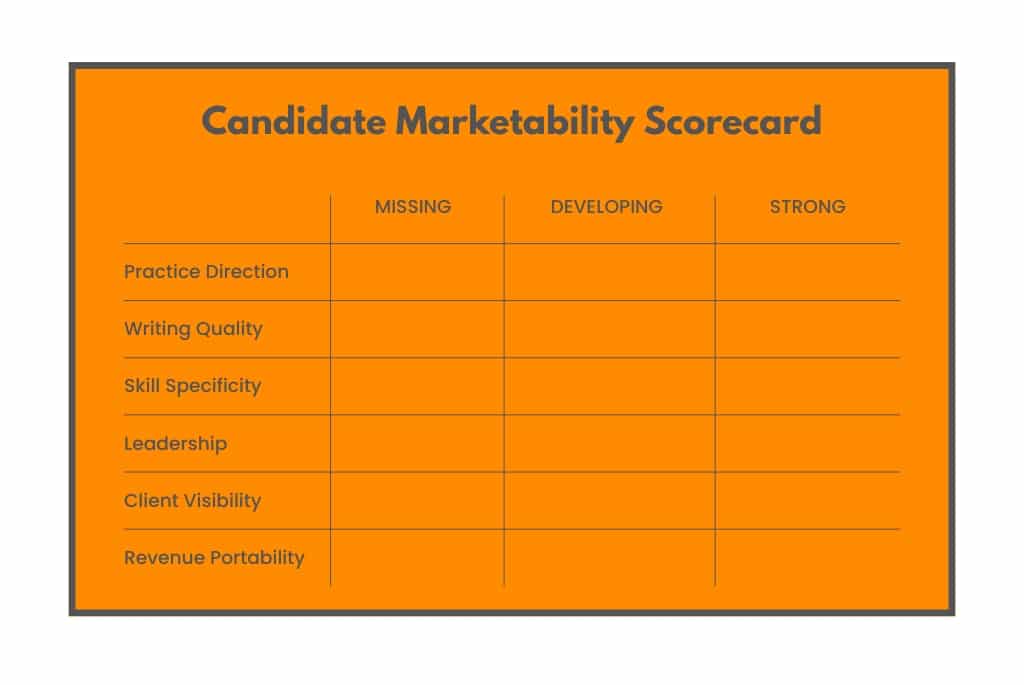
Marketability doesn’t appear overnight. It gets built in the details: matter ownership, writing quality, client exposure, and a career story that makes sense.
If you want a recruiter to advocate for you, give them something they can defend in a partner meeting. Specifics, outcomes, and a trajectory that holds up under scrutiny.
Looking for a legal recruiter to work with? Contact the team at Prime Legal and let us know how we can help you!
