Blog - Legal Jobs in Demand: Litigation Paralegal Jobs | Career Guide

Litigation paralegal jobs are gaining ground in 2026 for a reason that has little to do with headline growth statistics. Law firms are rebalancing how litigation work gets done. Associates are more expensive. Clients are less tolerant of inefficiency. Discovery obligations keep expanding. The result is a quiet shift of responsibility toward experienced litigation paralegals.
For job seekers evaluating legal jobs in demand, this role offers something unusual. Consistent hiring across firm sizes, rising compensation for specialized experience, and relevance that is tied to workload reality rather than trend cycles.
This is not a role growing because the profession is expanding. It is growing because litigation teams cannot function without it.
Why Litigation Paralegal Jobs Are in Demand in 2026
Litigation hiring patterns changed after 2020 and never fully reverted. Courts may appear operational again, but case flow tells a different story.
The Administrative Office of the U.S. Courts continues to report elevated civil caseloads in several districts, particularly in employment, tort, and contract litigation. These matters tend to be discovery-heavy and procedural, which places pressure on litigation support functions.
At the same time, firms are trimming junior associate leverage. Clients increasingly challenge bills for document review, scheduling coordination, and procedural filings. That work still has to happen. It’s simply moving to roles that deliver speed and consistency without associate-level billing.
Litigation paralegal jobs sit directly in that gap. They absorb operational responsibility that firms cannot eliminate and cannot afford to staff inefficiently.
What Litigation Paralegals Are Responsible for in 2026
The modern litigation paralegal role is defined less by task lists and more by control points.
Where Paralegals Carry Real Ownership
Most employers now expect litigation paralegals to manage entire segments of a case lifecycle. Common responsibilities include:
- Coordinating discovery strategy execution, including ESI workflows
- Drafting pleadings, subpoenas, and discovery responses under attorney supervision
- Managing deposition logistics, expert materials, and trial preparation
- Maintaining case databases and court filing calendars
- Acting as the primary interface with vendors and court clerks
In practice, this often means fewer paralegals per team with broader authority. Firms are willing to pay for reliability because the cost of a missed deadline or discovery error is higher than the salary premium.
Practice Areas Driving the Most Hiring
Demand for litigation paralegal jobs is not evenly distributed. Hiring remains strongest in practice areas where volume and complexity intersect:
- Commercial litigation with accelerated discovery schedules
- Employment and labor disputes involving multi-plaintiff claims
- Product liability and mass tort litigation
- Insurance defense practices with heavy document flow
- Regulatory and white-collar matters requiring procedural precision
These areas generate sustained work rather than episodic spikes, which supports long-term hiring.
Litigation Paralegal Pay Trends Across the United States
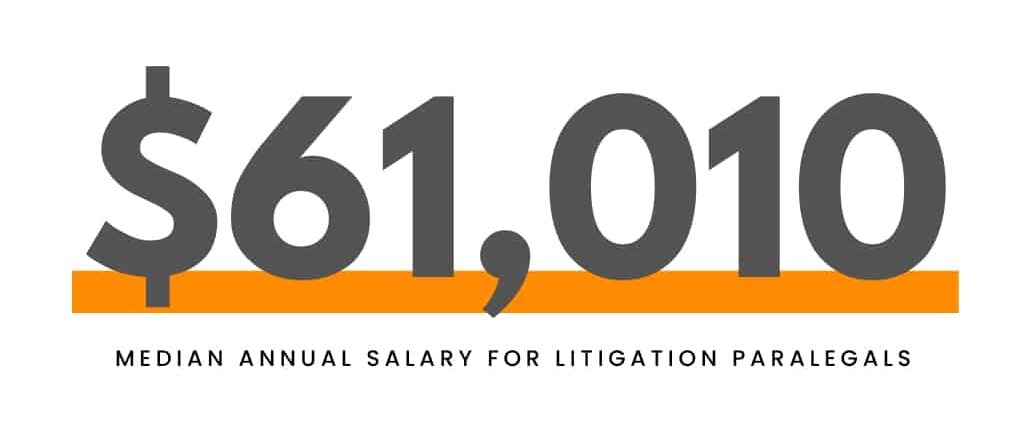
Compensation for litigation paralegals continues to rise, but not uniformly. The U.S. Bureau of Labor Statistics reports a median annual wage of $61,010 for paralegals and legal assistants as of May 2024. That figure understates what experienced litigation paralegals earn in practice. The spread between generalist and specialized roles is widening.
What Actually Drives Higher Pay
Salary variation is less about cost of living and more about exposure to risk and volume.
Paralegals who support trial teams, manage large discovery sets, or operate within compressed court schedules command higher compensation because mistakes carry financial consequences. Firms pay to reduce friction.
Typical ranges seen entering 2026 include:
- Early-career litigation paralegals: $50,000 to $65,000
- Mid-level litigation paralegals with case ownership: $65,000 to $85,000
- Senior or trial-focused litigation paralegals: $85,000 to $110,000+
Bonus eligibility is increasingly tied to trial calendars and matter load rather than firmwide performance.
Who’s Hiring Litigation Paralegals in 2026
Hiring demand spans multiple employer types, but expectations vary sharply.
Law Firms
Large firms continue to hire litigation paralegals who can step into active matters with minimal training. Mid-size litigation boutiques often look for fewer hires with broader scope, favoring candidates who have handled filings, discovery, and trial prep independently.
Corporate Legal Departments
In-house teams are adding litigation paralegals to reduce outside counsel spending and manage vendor relationships. These roles emphasize coordination, reporting, and document control over billable throughput.
Government and Regulatory Agencies
Federal and state agencies remain consistent employers, particularly in enforcement and administrative litigation. While compensation may trail private practice, stability and predictable hours remain differentiators.
Alternative Legal Service Providers
ALSPs continue to expand litigation support functions tied to discovery and regulatory response. These roles reward process discipline and technical fluency over firm pedigree.
How Litigation Paralegal Jobs Are Quietly Changing
Two shifts are reshaping expectations in ways many candidates underestimate.
First, technology competence is assumed. Employers no longer treat e-discovery platforms as a bonus skill. Paralegals are expected to operate Relativity, Everlaw, or comparable systems without onboarding time.
Second, performance is measured differently. Firms are tracking error rates, turnaround time, and procedural accuracy. Hours matter less than whether deadlines are met and disputes avoided.
This favors paralegals who think in systems. Those who rely on attorney direction for sequencing work are increasingly screened out.
How Candidates Are Getting Hired in This Market
The hiring bar for litigation paralegal jobs is higher, but it is also clearer.
Experience Signals That Matter
Hiring managers consistently prioritize:
- Direct litigation support rather than general legal exposure
- Ownership of discovery or trial preparation workflows
- Familiarity with specific courts or jurisdictions
- Evidence of handling multiple matters simultaneously
Credentials without context rarely move a resume forward.
What Interviews Are Actually Testing
Interviews often focus on pressure points rather than credentials. Missed filings, late productions, and conflicting deadlines. Candidates who explain how they prevent problems, not just how they react to them, advance.
A paralegal who can articulate how work is sequenced across a case signals readiness for modern litigation teams.
Where Prime Legal Observes the Market Shifting
Prime Legal works closely with litigation teams navigating tighter staffing models. Across markets, firms are consolidating responsibility rather than expanding their teams.
The consistent theme is caution. Hiring decisions carry more operational risk than they did five years ago. Firms are prioritizing candidates who reduce friction on day one.
What This Means for Litigation Paralegal Candidates
Litigation paralegal jobs will remain among the most stable legal jobs in demand through 2026. Stability, however, does not mean accessibility.
The market favors candidates who document their experience precisely, understand litigation mechanics, and operate comfortably under procedural pressure. Those expectations are unlikely to soften.
This role is no longer a stepping stone, it’s a core operational position. And firms are hiring accordingly.
