Blog - 2026 Legal Trends: How Working in Office Policies Are Reshaping Legal Tenure

In 2026, “return to office” isn’t a minor policy update.
It’s one of the most important legal trends shaping who stays, who leaves, and who gets promoted. Because working in office has become a signal: culture, commitment, mentorship, visibility, and (sometimes) control.
But here’s what most firms miss: the office only helps retention when it delivers real value like faster learning, better collaboration, and clearer growth.
That’s exactly why Prime Legal is focusing on what’s really happening this year. We’ll break down the forces driving office expectations, the real-world retention impact of those decisions, and the practical moves firms can make to boost legal tenure without turning office days into a battle.
Working in Office: The Flashpoint Legal Trend of 2026
Return-to-office talk isn’t new. What’s new is how directly it’s colliding with retention, productivity, and firm economics.
In the broader workforce, hybrid work has stabilized instead of disappearing. Gallup reporting summarized by HR Dive notes hybrid workers average 46% of their workweek in the office (about 2.3 days/week).
Translation: many professionals now treat hybrid work as the default setting.
Law firms, on the other hand, are increasingly treating office presence as a strategic lever, especially in Big Law and larger regional firms.
One of the clearest signals isn’t a policy memo. It’s real estate.
Reuters reported that law firms accounted for 10.5% of U.S. office leasing activity through Q3 2025, roughly double pre-pandemic levels (~5%). The legal sector leased 8.3 million square feet through Q3 2025.
When firms invest that kind of money in space, they tend to want bodies in it.
Legal Tenure in 2026: The Retention Problem
In 2026, legal tenure is a competitive advantage.
Why? Because replacing legal talent is expensive in ways most firms underestimate:
- lost client continuity
- ramp time (especially for specialized practice groups)
- partner time spent “rebuilding the bench”
- operational drag (conflicts checks, onboarding, training, workflow resets)
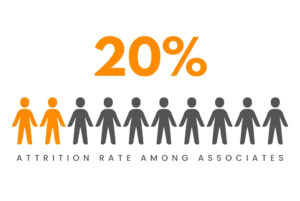
And the data shows churn is still very real. The NALP Foundation’s latest update on associate attrition reported an overall associate attrition rate of 20% (up from 18% in 2023, below the 2021 high of 26%). That number matters because attrition isn’t just a “people issue.” It’s a capacity issue. When enough people leave, firms lose their leverage.
The Hidden Link Between Working in Office and Tenure: Office Value
Here’s the mistake firms make: They treat “working in office” as a binary.
In-office = committed
Remote = disengaged
But the best-run legal teams are thinking in a different frame: If someone is going to commute, the office has to earn it.
So, the question becomes:
What do lawyers actually want the office to do?
In 2026, the office tends to earn its keep when it reliably delivers at least one of these outcomes:
Faster learning: Juniors get sharper when feedback is immediate and informal.
Higher-quality collaboration: Some work is just easier when you can whiteboard, workshop, and resolve issues in minutes.
Client-facing credibility: Certain clients still associate in-person presence with responsiveness and seriousness.
Community and identity: People stay longer where they feel known, coached, and invested in.
If your office experience doesn’t deliver these, the policy starts to feel like punishment. And punishment doesn’t build tenure.
2026 Legal Trend: Offices are Getting Bigger (Yes, Bigger)
This might surprise you because most industries have trimmed office footprints. But law firms are moving differently.
Reuters described how many large firms now require lawyers to be in the office at least four days a week, and how firms are using dedicated office space as a recruiting tool while many other sectors reduce their footprints. In other words, the office isn’t just a workplace. It’s positioning.
Prime Legal takeaway
If competitors in your market are going in-office, your firm faces a strategic choice: match them and sell the culture or differentiate with flexibility and outcomes. Either path can work. But drifting (unclear policy, inconsistent enforcement, “it depends who your partner is”) is the worst option because it creates resentment without clarity.
Consolidation and Scale: How They Impact Tenure
Reuters reported that law firm mergers rose 18% in 2025 (59 mergers vs. 50 in 2024), with expectations of more consolidation in 2026 driven by rising talent and tech costs.
Consolidation changes tenure dynamics because it often triggers:
- practice group reshuffles
- compensation harmonization
- new leadership layers
- cultural mismatch (the silent killer)
In practical terms: mergers can improve capability and increase flight risk.
So, if your firm is growing (or being acquired, or merging), retention strategy can’t be a side project. It needs a plan.
AI is Reshaping Workflows… and Raising the Bar for Judgment
As you’ve probably noticed by now, AI is being integrated into the workforce fully in 2026. Thomson Reuters’ 2025 Generative AI in Professional Services Report notes that about half of professionals across surveyed sectors (including legal) use GenAI in some fashion.
But adoption creates two opposing forces for tenure:
Force #1: Less Burnout (Good for Tenure)
AI can reduce low-value drafting and repetitive research leading to less burnout among employees.
Force #2: More Risk (Bad for Tenure if Unmanaged)
Courts and regulators are paying attention to AI errors. Reuters has reported incidents where AI “hallucinations” (fabricated citations) in filings led to potential sanctions and public scrutiny. That means firms need more training, more policy, and more review rigor. And that changes what “good” looks like for junior and mid-level lawyers.
In 2026, tenure increasingly goes to firms that train people to work with new tools safely instead of expecting associates to figure it out alone.
7 Practical Ways to Improve Tenure Without Abandoning Working in Office
Here are strategies that move the needle without starting a civil war over office days.
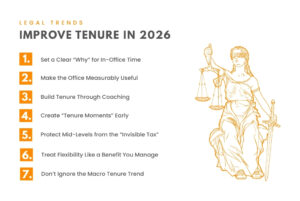
1) Set a Clear “Why” for In-Office Time
If the firm wants 3-4 days in office, define the purpose.
Examples:
- Tues–Thurs are collaboration days
- Mon/Fri are flexible deep-work days
- Certain practice groups align to court/client rhythms
Clarity reduces friction.
2) Make the Office Measurably Useful
Upgrade the experience by creating:
- protected quiet zones
- reliable conference room availability
- better hybrid meeting tech
- fewer “come in to sit on Zoom” days
3) Build Tenure Through Coaching
Retention is rarely about free snacks.
It’s about:
- predictable feedback
- real skill development
- transparent promotion signals
NALP’s retention research emphasizes that associates pay close attention to career path clarity and factors tied to long-term growth.
4) Create “Tenure Moments” Early
Most retention is decided in the first year. Prime Legal recommendation: formalize three moments.
Day 30: expectations + workflow norms
Day 90: skill review + training plan
Month 6: “stay interview” (what would make you leave?)
5) Protect Mid-Levels from the “Invisible Tax”
Mid-level associates often carry:
- mentoring load
- project management
- client comms
- plus billables
That’s how people burn out quietly.
If you want tenure, you also need workload realism.
6) Treat Flexibility Like a Benefit You Manage
Flexibility doesn’t have to mean chaos.
Firms can:
- standardize core collaboration hours
- define response-time norms
- encourage predictable office days per team
When the rules are fair, people stop negotiating them emotionally.
7) Don’t Ignore the Macro Tenure Trend
Even outside law, long tenure isn’t guaranteed anymore. BLS data shows median employee tenure was 3.9 years for wage and salary workers overall. So, when a firm builds teams that stay 4-6+ years? That’s a performance advantage.
The Bottom Line for 2026
In 2026, legal trends aren’t just about technology, billing models, or mergers. They’re about the day-to-day reality of working in an office and whether that reality makes talented people want to stay.
Prime Legal’s view is simple:
- If you want longer tenure, don’t just require presence.
- Make presence valuable.
- Back it up with coaching, clarity, and modern workflows.
In 2026, that’s how firms win without burning out the very people they’re trying to bring together.
